
EUDI Wallet Is Coming: What Businesses Need to Know Before 2027
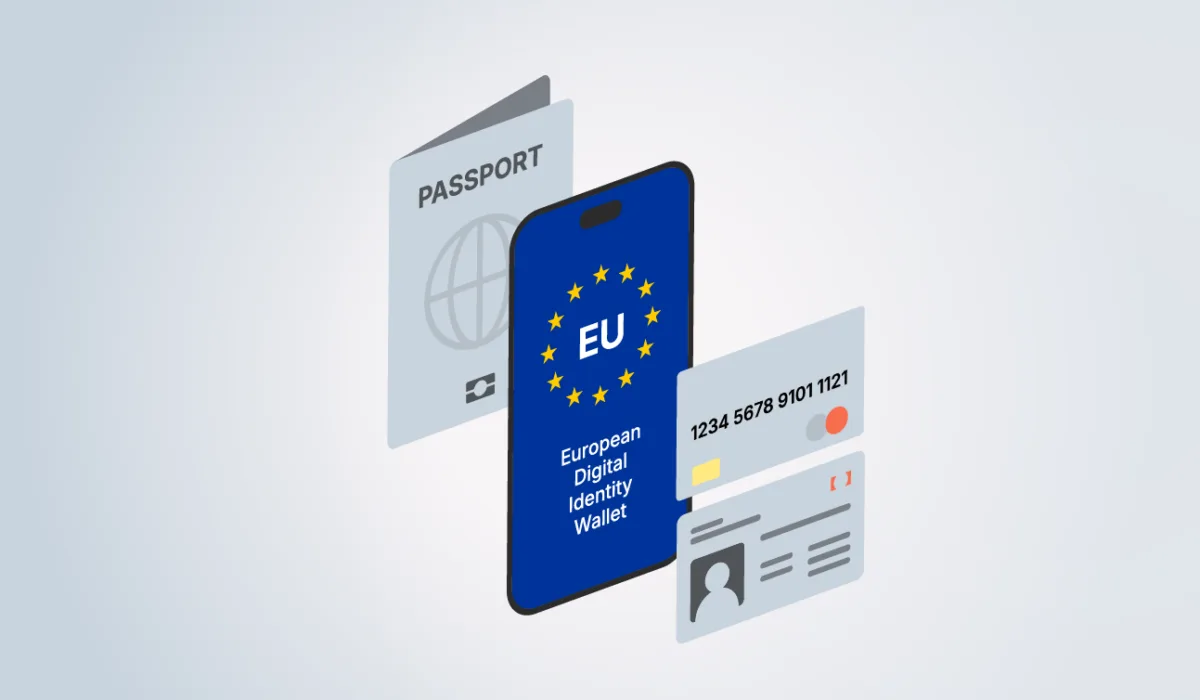

The European Digital Identity (EUDI) Wallet is designed to make identity verification simpler – customers can share verified information from a secure app instead of repeatedly uploading ID documents or disclosing more personal data than necessary. For businesses, EUDI offers a way to optimize onboarding and reduce manual document handling.
With EU countries required to provide wallets by the end of 2026, businesses should start preparing now. Accepting wallet-based identity will require changes to technology, customer journeys, and compliance processes.
This article explains what the EUDI Wallet is, when it is coming, what it changes for identity verification and Know Your Customer (KYC), and how your business can get ready.
What Is the EUDI Wallet?
Digital identity is already familiar to many customers.
According to Eurostat, 52% of EU residents (aged 16–74) used electronic identification to access online services for personal purposes in 2025.
The EUDI Wallet is a digital identity application developed under the EU’s updated electronic identification framework, commonly called eIDAS 2.0.
However, it is not one app issued centrally by Brussels. EU Member States must provide at least one wallet, either directly, through an authorized provider, or by recognizing an independently provided wallet. These wallets are to follow common EU requirements.
Users will be able to identify themselves, share verified information, present digital credentials such as qualifications, and electronically sign documents. Unlike a folder containing photographs of an ID, the wallet supports data that services can validate electronically.
It’s important to note that using the wallet is voluntary for individuals, and personal use is free. This means that people who choose not to use EUDI Wallet must retain access to alternative ways of accessing services.
When Will the EUDI Wallet Be Available?
Now, we need to address the important distinction between wallet availability and business acceptance requirements.
- By the end of 2026: EU Member States must provide wallets. Notably, it’s the EU-wide availability milestone, but not a promise that every credential and commercial use case will work everywhere immediately.
- By the end of 2027: Certain private service providers must accept them. The obligation depends on the service and its authentication requirements; it does not apply indiscriminately to every business.
National launch schedules also need attention.
In September 2026, Germany announced January 2, 2027, as the launch date for its state wallet, with additional capabilities arriving afterward. Businesses should therefore track the markets they serve rather than assume one simultaneous, fully featured launch.
Preparation is already in full swing. The EC EUDI Wallet program states that 6 large-scale pilot projects are already testing the wallet across more than 11 everyday use cases, involving 550 private companies and public authorities in 26 EU Member States, plus Norway, Iceland, and Ukraine.
Pilot participation, however, is not the same as production availability.
Why Does the EUDI Wallet Matter for Businesses?

The practical opportunity of the EUDI is to reduce repeated work while keeping verification reliable. Here are the main advantages that the introduction of the EUDI Wallet is set to bring to businesses.
Less document handling
Receiving verified identity information could reduce manual data entry, repeated uploads, and some document-review tasks. The Commission identifies simpler identity verification and lower authentication costs as potential benefits, not guaranteed savings for every implementation.
More consistent cross-border verification
Common technical standards are designed to let businesses exchange information with wallets from different Member States. This approach can support a more consistent process for customers from multiple EU markets.
Less unnecessary personal data use
Consider a service that only needs to establish whether someone is 18 or older. Instead of requesting a complete ID document, it could request proof that the age threshold is met. For example, Germany’s official wallet guidance explains this selective-disclosure approach – age verification need not reveal a full date of birth!
The EUDI Wallet is set to minimize the amount of data collected during identity and age verification.
How Will It Change Identity Verification and KYC?
The EUDI Wallet can serve as another trusted source of identity, but it won’t replace your entire Know Your Customer (KYC) process.
The Financial Action Task Force’s digital identity guidance recognizes digital ID as a potential tool for Customer Due Diligence (CDD). Businesses still need to assess whether the identity system’s assurance and reliability are appropriate for the risks involved.
Let’s consider a typical account-opening journey:
Document-based verification. A customer uploads an ID, completes a selfie or another identity check where required, and corrects missing or unreadable information.
Wallet-based verification. The customer chooses the wallet option, reviews the requested information, and approves sharing it. Then, the business validates the digital identity verification evidence before using it in its onboarding process. The EU Commission’s service-provider guide describes this as the “request, approval, and validation” model.
The identity evidence changes. But the wider compliance decision does not disappear.
Applicable Anti-Money Laundering (AML) sanctions checks, Politically Exposed Person (PEP) checks, customer risk assessment, Ultimate Beneficial Ownership (UBO) checks, and ongoing monitoring remain separate responsibilities.
The FATF Recommendations distinguish identity verification from these broader controls. A verified identity is not proof that a customer or transaction is low risk.
“The EUDI Wallet won’t kill KYC vendors. It’ll only kill the bad ones.” — Liudas Kanapienis, CEO & Co-Founder, Ondato
👉 Read the whole opinion article by Ondato’s CEO on the effect the EUDI Wallet may have on KYC providers here.
Which Businesses Will Be Affected?
The most relevant opportunities include:
| Business area | Potential wallet use |
| Financial services and fintech | Account opening and customer identification |
| Telecommunications | Identity checks for customer or SIM registration |
| Travel and hospitality | Guest identification and hotel check-in |
| Education and healthcare | Sharing qualifications or health insurance credentials |
Age-restricted businesses can also explore age-threshold proofs instead of collecting full identity details when age alone is sufficient.
However, a useful use case is not automatically a legal acceptance obligation.
Under Article 5f, the private-sector requirement covers qualifying providers required by EU law, national law, or contract to use strong user authentication for online identification. Acceptance is required at the user’s voluntary request, with an exemption for microenterprises and small enterprises as defined in the legislation. Public services and designated very large online platforms have separate acceptance provisions.
What Should Businesses Do Now?
Here are six practical steps your business can take now to get ready for the EUDI Wallet.
STEP 1. Start with one customer journey
Choose a process where wallet-based evidence could solve a specific problem: repeated ID capture, difficult crossborder onboarding, or unnecessary data collection.
- Assign a shared owner across product, compliance, and engineering.
- Confirm whether your service falls within mandatory acceptance rules, which national launches matter, and what success would look like.
- Avoid beginning with a company-wide replacement project.
STEP 2. Map the identity information you actually need
Create an attribute checklist for the selected journey by separating legally required information from information that is merely convenient.
An age check may need only an age-threshold result. Meanwhile, account opening may require several identity attributes, as well as additional customer information.
For each field, ask: Can a wallet supply it? Is the issuer acceptable? What happens when it is missing? Do not design your process around the assumption that every wallet will contain every useful credential.
STEP 3. Plan the integration, not just the interface
Ask your technology team or your IDV provider how wallet evidence will be incorporated into your existing decision process.
Use the EU Commission’s Architecture and Reference Framework resources as the technical starting point to set common standards, protocols, and data formats. Make sure your integration implements them correctly.
Evaluate how the solution will check issuer trust, digital signatures, credential validity, and revocation, where applicable. Ask how the solution connects the evidence to the current user and session.
Request demonstrations across relevant wallets and countries, along with a clear maintenance plan as specifications evolve.
STEP 4. Redesign the customer experience
Make the wallet an understandable choice. Explain what information your business is requesting and why, and provide a clear route back when sharing fails or is canceled.
Test both mobile onboarding and journeys that begin on a computer. Include accessibility testing and support instructions.
The wallet model gives users visibility into who is requesting their information and for what purpose. Your onboarding language should make that transparency useful rather than confusing.
STEP 5. Prepare registration, privacy, and audit controls
Businesses accepting wallet data act as “relying parties”. The Commission says they must register in their Member State of establishment and declare their intended use and requested data. They must not request additional data beyond the declared scope.
Prepare that registration alongside your privacy review. Document the lawful basis for processing, retention periods, access controls, and verification evidence. Assess whether a data protection impact assessment is required; wallet integration does not remove those responsibilities.
Keep wallet-based identity evidence connected to your risk assessment and compliance records.
STEP 6. Keep fallbacks and test real outcomes
Plan for customers without wallets, unavailable credentials, lost devices, and technical failures. Maintain suitable document-based or other accepted verification methods without creating an easier route around necessary controls.
Bear in mind that adoption will not be uniform.
Eurostat’s 2025 figures show that the existing Electronic ID (eID) use ranges from 99% in Denmark to 15% in Germany. These are not EUDI adoption forecasts, but they are a useful reminder not to design around a single customer profile.
And it’s best to pilot the new route before expanding it. Measure completion rates, verification time, manual referrals, support requests, and fallback usage. Judge success by the whole onboarding journey, not simply whether the wallet connection works.
Preparing for EUDI Wallet
The EUDI Wallet is a reason to make identity verification more flexible, not to bet everything on one method.
Three top priorities now are:
- Start with a clear use case,
- Request only the information you need,
- Preserve the controls and alternatives that keep your business operating safely.
For companies reviewing their setup, that creates a practical starting point for a conversation with Ondato: your customer markets, onboarding requirements, fallback coverage, and roadmap for wallet-based identity.
Your goal is to come up with a verification approach that solves today’s problems while leaving room for tomorrow’s trusted identity sources.
FAQ


