
How the EU’s MiCA Regulation Affects the Crypto Market

For years, crypto regulation in Europe felt like an archipelago of independent islands – each with its own rules: one rulebook in France, another in Germany, a totally different vibe in Spain, and a lot of “it depends” everywhere else. That era is now over.
Fully adopted across the European Union (EU) in 2024, Markets in Crypto-Assets Regulation (MiCA) is the world’s first comprehensive regulatory framework for digital assets, which has reshaped how crypto companies design products, market services, manage risk, and expand internationally. And even if your business isn’t based in Europe, MiCA still matters, because the EU is a huge market of 450 million people, and a unified licensing model creates a blueprint that other jurisdictions can (and likely will) copy.
In this article, we will break down what MiCA is, what it changes, and what crypto businesses should prioritize right now.
What is MiCA?
At its core, MiCA, aka Regulation (EU) 2023/1114, is a binding, EU-wide legislative framework designed to bring order to the crypto-asset ecosystem and ensure financial stability. And, unlike previous patchwork national rules, MiCA applies uniformly across all 27 EU member states, targeting:
- Crypto-Asset Service Providers (CASPs) – exchanges, custodians, brokers, and advisory firms.
- Asset-Referenced Tokens (ARTs) – stablecoins backed by multiple assets or currencies, like a basket of fiat currency or gold.
- E-Money Tokens (EMTs) – stablecoins pegged to a single fiat currency, like a Euro-pegged stablecoin.
MiCA is organized into different “titles”:
- Title II applies to rules for crypto assets that are not ARTs or EMTs, often the “general token” category.
- Title III applies to rules for ARTs: stablecoins referencing multiple assets, commodities, etc.
- Title IV applies to rules for EMTs: stablecoins pegged to a single fiat currency.
- Title V applies to rules for CASPs: their authorization, governance, and operational safeguards.
The rollout was phased for stability. Thus, the rules for stablecoins (Titles III and IV) kicked in on June 30, 2024, while the full regime for service providers became mandatory later on December 30, 2024.
From the legislation standpoint, MiCA is deeply integrated with such existing EU laws as GDPR – for data privacy; eIDAS – for electronic identification standards; and AMLA– the new EU Anti-Money Laundering Authority, which ensures crypto isn’t used for illicit finance.
Why MiCA Needs DORA
You can’t talk about MiCA without mentioning its “technical twin” – DORA (Digital Operational Resilience Act). While MiCA handles the legal side of crypto, DORA handles the cybersecurity side.
So, if you are a licensed CASP, DORA requires you to:
- Conduct “stress tests” – You must regularly simulate cyberattacks on your own systems to find weaknesses.
- Manage your vendors – You are legally responsible for the security of any third-party cloud or software provider you use.
- Cybersecurity governance – Under DORA, a crypto asset market participant’s Board of Directors is personally responsible for the firm’s digital resilience.
The Main MiCA Objectives
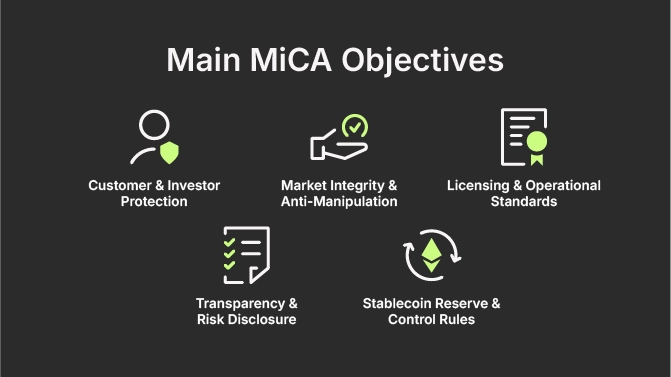
First and foremost, MiCA was designed to provide a unified crypto licensing regime for the entire EU. No more 27 different national approaches for core crypto operations. In practice, this means that if a crypto exchange gets licensed in Spain, it is now able to offer the same services in Germany or France under the same core MiCA rules, instead of redesigning its operations for each country.
As to other objectives of MiCA’s implementation, these are:
Consumer and Investor Protection
MiCA requires crypto businesses to inform customers and holders about the characteristics, functions, and risks of crypto-assets they intend to purchase. This means that people using crypto platforms are now better protected from misleading info, unfair practices, and unsafe handling of their funds.
EXAMPLE: A platform can’t advertise a token as “low-risk” without proper warnings. And if the platform holds your crypto, it must follow rules on safeguarding client assets, so your funds aren’t treated like the company’s own money.
Market Integrity and Anti-Manipulation Expectations
MiCA aims to reduce unregulated trading behavior by introducing integrity requirements, oversight mechanisms, and clearer supervisory powers, which means less insider trading, fake trading volume, pump-and-dump schemes, and price manipulation. This way crypto should start functioning more like regulated financial markets.
EXAMPLE: If a group coordinates to artificially spike a token price (“pump”), sells at the top, and leaves regular users holding losses (“dump”), MiCA gives regulators clearer tools to treat this as market manipulation and act against it.
Licensing and Operational Standards for CASPs
MiCA requires CASPs to be authorized and meet governance, security, and operational resilience standards. In other words, crypto businesses must be licensed to offer services (like exchanges, custody, trading platforms). This requirement raises the bar, so users deal with more reliable, supervised companies.
EXAMPLE: A wallet provider offering custody can’t just launch in the EU with a website and app. Under MiCA, it needs authorization and must prove it has proper security controls, internal policies, and reliable systems to protect customers.
Transparency and Risk Disclosure Obligations
Token issuers must provide standardized information (often via crypto asset white papers), so users understand what they’re buying and what risks exist. This leads to less “mystery token” hype and fewer misleading launches.
EXAMPLE: Before offering a new token publicly, the issuer must publish a white paper that would explain what the token is for, how it works, key risks, and who is behind it, instead of just throwing around marketing slogans like “the next Bitcoin”.
Stablecoin Reserve and Control Rules
MiCA requires stablecoins to be properly backed and managed, so they can actually stay stable and be redeemed when users want out. Because stablecoins are used like “crypto cash”, failures can hurt a lot of people and markets fast.
EXAMPLE: If a euro stablecoin says “1 token = €1″, the issuer must have reserves and systems so users can redeem tokens for euros. It can’t run on vague promises or risky backing that collapses under pressure.
Finally, MiCA was created to fight financial crimes, such as money laundering, terrorist financing, and sanctions circumvention. The European Commission achieves this by setting strict Anti-Money Laundering (AML) requirements for all crypto-asset service providers.
What MiCA Means for Crypto Companies and CASPs
For global businesses, the MiCA regulation means crypto operations in Europe are now only possible if you comply with the EU-grade standards. On the one hand, MiCA offers clean access to a massive European market; on the other hand, it demands strict compliance. Here are the major implications you should be aware of as a business owner.
First, it’s mandatory licensing/passporting, which means you can’t just “open a crypto exchange” anymore, you would need authorization from a National Competent Authority (NCA). So, a crypto exchange can only expand across the EU using passporting.
Second is the “fit and proper” management requirement, which according to the MiCA crypto assets regulation means that your business’ leadership must be competent, reputable, and capable. To ensure that, MiCA regulators will look closely at your governance structures and decision-makers.
Third, CASPs must hold minimal capital and maintain financial safeguards, for example, trading platforms typically need at least €150,000 in their own funds and meet reserve and redemption rules.
Next, crypto exchanges wishing to operate in the EU member states must be able to manage their risks and handle complaints, just like typical corporate institutions would. We’re talking about internal risk management mechanisms, operational resilience tools, and customer complaint procedures.
Fifth, it’s the white paper obligation. Meaning that before you decide to offer a token in the EU, you must publish a detailed white paper that explains your offer’s technical standards used, risks, and environmental impact.
And finally, MiCA demands stricter identity verification and (AML) processes. MiCA itself isn’t the AML regulation, but it’s designed to align with the EU’s AML expectations. Combined with EU AML reforms, CASPs should expect tighter end-to-end compliance expectations.
Top 7 MiCA Compliance Requirements for Crypto Businesses
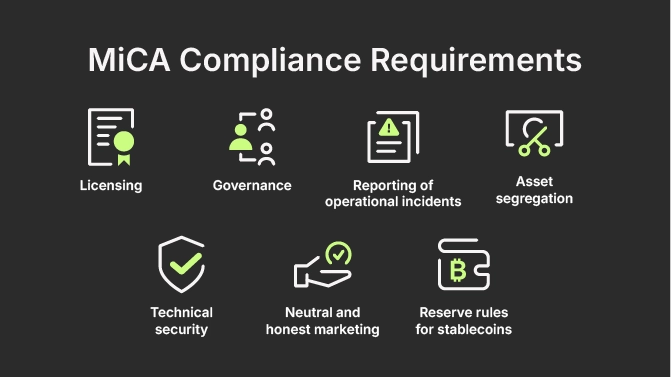
Regulatory compliance with MiCA is now a “day-to-day” operation involving a number of mandatory steps. So, if you’re preparing for MiCA (or supporting clients who are), think of it as six big workstreams:
- Licensing for CASPs
Here is what a typical authorization/passporting journey for a CASP looks like:
- confirming your service scope (which CASP services you provide)
- preparing the required documentation and policies
- submitting the application to your regional NCA
- demonstrating operational readiness (people, process, tech, controls)
You can find out more about the European Securities and Markets Authority (ESMA) authorization expectations and reporting standards here.
- Governance requirements
Make sure you pay attention to MiCA’s requirements around your organizational structure, senior management responsibilities, internal control functions, and conflicts of interests. Also, if you operate in an EU-based office, you’d need to have at least one resident director.
- Reporting and incident notifications
CASPs are also required to document and report operational incidents, support requests, and maintain proper records for future oversight. Put simply, you’ll have to submit regular incident notifications to regulators if the system gets hacked or goes down.
- Asset segregation
CASP must ensure that client assets are legally and technically isolated from the company’s own operating funds; i.e. kept in separate buckets, so that the “client bucket” stays untouchable by the company’s creditors and is held in separate on-chain addresses or sub-accounts.
- Technical security obligations
When it comes to technical security, EU-based crypto assets service providers should have stringent cybersecurity controls, show operational resilience and continuity plans, and secure custody safeguards (for custodial providers).
- Neutral and honest marketing communications
MiCA requires crypto businesses to get rid of the marketing hype, like empty promises to get rich quick or “guaranteed results”, as well as tiny, illegible print. Instead, marketing messages should be consistent with your official promises and capabilities, contain risk warnings, and all influencers should clearly disclose if they are being paid to advertise a crypto service.
- Reserve rules for stablecoins
Issuers of ARTs and EMTs must manage their reserves with extreme caution. For “significant” stablecoins (those with over 10 million users or €5 billion in assets), the European Banking Authority (EBA) takes over direct supervision.
Quick Test: Are You MiCA-Ready?
If you can confidently say “yes” to these, you’re on the right track:
- We know exactly which CASP services we provide under MiCA
- We have a complete authorization package and governance structure
- We can demonstrate client asset safeguarding and operational resilience
- We have strong Know Your Customer (KYC) / AML controls and incident reporting processes
- Our marketing and disclosures are clear and compliant
MiCA and Stablecoins: What Changes for ART and EMT Issuers?
Starting from June 30, 2024, the new rules for the issuers of ART and e-money tokens (EMT) came into effect. Prohibiting the users from granting interest, the new MiCA rules ensure stablecoins are used as a payment tool, not a high-yield savings account that could destabilize the banking system.
These two types of stablecoins can affect the economy differently, for example, EMTs can feel like money (like digital cash on blockchain), so they’re treated more strictly, and ARTs can be more complex (because they depend on multiple assets), so they need stricter rules too. Basically, EMT is one currency stablecoin, like a digital euro, and ART is a basket stablecoin, like a mixed savings fund.
MiCA Regulation’s Timeline
We are currently in the final “settling” period for MiCA. Here is the practical timeline most crypto asset service providers should know:
June 30, 2024 – Rules for stablecoin (ART/EMT) issuers were applied first.
December 30, 2024 – All CASP licensing requirements became mandatory. This was the “full applicability” milestone for most of MiCA’s operational regime.
July 1, 2026 – The hard deadline for the transitional period. Companies that were already operating under old national laws must have their full MiCA authorisation by this date or stop operating in the EU.
Here is what businesses should prioritize first:
- If you issue stablecoins: ART/EMT compliance is urgent.
- If you’re a CASP: authorization readiness, i.e. governance, controls, and documentation, should be your main focus.
Pro-tip for crypto businesses: If you haven’t started your application with an NCA (like BaFin in Germany or the AFM in the Netherlands), you’re already behind.
MiCA vs. Other Global Crypto Regulations
Without doubt, MiCA’s framework nowadays is the “North Star” of crypto regulation, inspiring other global players to follow suit and create one rulebook and one authorization mechanism for each country/region.
Here is what’s happening in other crypto asset markets right now.
The United States
The US still remains a patchwork of federal, state, and agency oversights that heavily depend on: SEC interpretations (securities), CFTC involvement (commodities/derivatives), the US Treasury /FinCEN for AML, and state regimes like New York’s BitLicense (NYDFS).
The SEC continues to treat crypto policy as cross-division work, including via dedicated crypto task force efforts.
The United Kingdom
The country is taking a “phased” approach by expanding existing financial laws to include crypto, rather than a standalone law like MiCA. It’s building a financial services-style crypto regime via draft legislation and FCA frameworks, but reporting indicates the regime is expected to start in October 2027, which is later than the EU’s MiCA timeline.
Singapore (APAC)
Singapore regulates crypto firms under MAS frameworks, like the Payment Services Act and related updates, and is tightening expectations, including licensing obligations for certain digital token service providers starting June 30, 2025.
| Jurisdiction | Key features | Contrast to MiCA |
| EU (MiCA) | Unified licensing, passporting, proactive disclosures | Comprehensive bloc-wide clarity |
| UK | Post-Brexit FCA rules, stablecoin focus | Similar but no passporting |
| US | SEC/CFTC enforcement patchwork, reactive lawsuits | Fragmented, enforcement-heavy |
| Singapore | MAS licensing, sandboxes | Controlled innovation, less unified |
At the moment, the MiCA regulation remains the most unified and comprehensive framework, and many countries are now “copy-pasting” its crypto asset white paper and passporting rules.
What’s Next?
Even though MiCA has just come into effect, Brussels is already talking about MiCA II, where all loose parts are going to be fixed, such as tokenized financial instruments, DeFi, NFTs, hybrid tokens, as well as the new business models that were not clearly defined.
Here is what we can expect to see in the nearest future:
- NFTs and DeFi. Most NFTs and truly decentralized finance (DeFi) were left out of the first version. We may expect new reports and rules by late 2026.
- ESMA and EBA guidance rollout. ESMA is publishing implementation materials and building out the MiCA register, including crypto asset white papers and authorized CASPs, with integration into ESMA systems expected by mid-2026. The EBA continues issuing standards and guidelines specifically for stablecoins (ARTs and EMTs).
- AMLA integration. The new Anti-Money Laundering Authority (AMLA) will start its heavy supervision of crypto transfers by mid-2026, making sure that the overall EU crypto compliance moves towards more consistent, centralized expectations.
- Institutional influx. According to recent data, 12 of the first 100+ CASP licenses were granted to traditional banks, signaling that corporate financial institutions are officially moving in.
- Global influence. It’s obvious that other jurisdictions are watching MiCA closely, because it shows how a major economic bloc can regulate crypto at scale without relying purely on enforcement.
Finally, one thing is clear – the MiCA regulation has successfully turned crypto from a speculative experiment into a legitimate pillar of the European digital economy. It pushes the crypto assets industry toward clear licensing, stronger customer protections, safer stablecoins, more transparent issuance, and more overall trust in the crypto ecosystem.
FAQ







Comments
What exactly do CASPs need to do to meet licensing criteria that the EU regulators set? What actions?
To get licensed as a CASP under MiCA, you'll need to apply to your national authority with these key proofs: solid internal governance setup, a robust risk management plan (covering AML/KYC), minimum capital reserves starting at €50K (scaling to €150K based on your services like custody or trading), and a full compliance program tailored to MiCA rules. This way you’ll be ready to operate safely across the EU member states. So, we advise that you start by checking your local regulator's portal for the exact forms.