
Credit Card Age Verification: Limitations, Risks, and Alternatives

Verifying a user’s age is crucial for ensuring compliance with legal requirements and protecting vulnerable populations, particularly when it comes to accessing age-restricted goods or services online. Credit card age verification has been a common method for years, but it comes with significant drawbacks. In contrast, ID-based age verification and age estimation have emerged as more effective and secure alternatives. In this article, we’ll explore the limitations of credit card age verification and explain why ID age verification and age estimation are better choices.
Understanding Credit Card Age Verification
Credit card age verification is a method websites and online services use to confirm that someone is old enough to access age-restricted content or make certain purchases. Instead of uploading an ID or going through multiple verification steps, you simply enter your credit card information. Since it is commonly assumed in most countries that you need to be at least 18 years old to have a credit card, this serves as quick proof that you’re an adult.
Let’s consider a typical example of the credit card age verification process:
When a person visits an online tobacco or vaping retailer’s website, before they can view the seller’s product catalog or add anything to their cart, the site prompts them to verify they’re at least 21 years old (or 18, depending on local laws).
Then, they enter their credit card information, and the system processes a small authorization hold, typically around $1, to confirm the card is legitimate and issued to an adult. Once verification goes through, the hold is released within a few days, and they can browse and shop freely.
Key Benefits of Credit Card Age Verification
The appeal of the credit card age verification method lies in its simplicity. Users don’t need to scan documents or wait for manual approval. Here are a few reasons why the credit card age verification process is a popular option for most businesses and users:
Easy implementation. For most businesses, choosing credit card age verification is the path of least resistance, as it’s based on the payment infrastructure they already have in place. No need to integrate specialized ID scanning software or build entirely new verification systems from scratch. Adding an age check through a credit card is practically plug-and-play for the companies that already process payments.
Familiar payment flow. People are used to entering their credit card information online. It feels routine, comfortable, almost automatic. Compare that to uploading a photo of your driver’s license, which can feel invasive or sketchy depending on the website. The credit card route just feels more normal to most users.
Perceived age signal. The widespread assumption is that if you have a credit card, you’re probably an adult. In most countries, the minimum legal age for getting a credit card is 18. But it’s not always the case, as teens can be authorized users on family accounts and get prepaid cards. Still, for lower-stakes situations, it’s good enough.
Use in low-risk scenarios. This method is often used on legacy platforms or in scenarios where the risk is relatively low. It’s not the gold standard for strict age verification, as regulated industries are increasingly moving toward more robust solutions. But, for businesses that need a quick, familiar checkpoint without heavy lifting, credit card verification still gets the job done.
Key Limitations of Credit Card-Based Age Checks
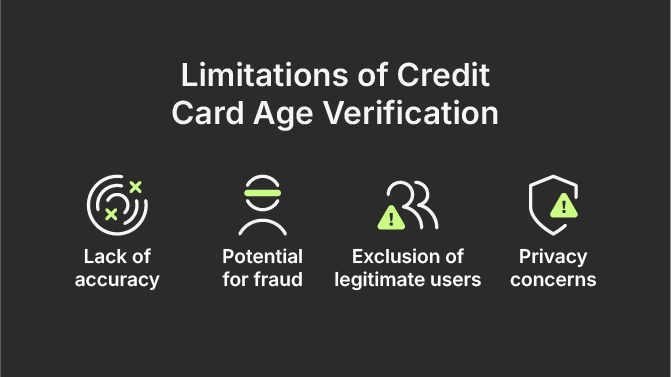
While credit card age verification is a convenient method, it has several notable drawbacks.
Lack of accuracy. Credit card ownership doesn’t actually prove you’re old enough, it just suggests you might be. In reality, minors can easily use a parent’s card with permission, or even without it. That family card sitting in the kitchen drawer becomes a free pass to bypass age restrictions entirely. So, while the system assumes that a credit card = adult, it’s really more of a loophole that makes credit card age verification an unreliable method for ensuring compliance with age-related laws.
Potential for fraud. Stolen or shared credit card information is also an argument against the method’s reliability. If a teen gets hold of someone else’s card details – whether through theft or a friend handing over their info – they can easily pass age verification. The system has no way of knowing who’s actually on the other side of that transaction, which pretty much defeats the purpose of having age checks in the first place.
Exclusion of legitimate users. Ironically, some perfectly legal adults don’t have credit cards. Maybe they prefer debit cards or cash, maybe they’re rebuilding their credit, or maybe they’ve just opted out of the credit system altogether. When businesses rely exclusively on credit card verification, they accidentally lock out people who have every right to access their services. This undermines the effectiveness of the age verification process.
Privacy concerns. Often, handing over your credit card details just to prove you’re old enough raises serious privacy concerns. After all, it’s sensitive financial information, and with data breaches making headlines regularly, people have good reason to be wary. Asking users to share payment credentials for a simple age check can feel invasive, especially when there’s no actual purchase involved.
Why ID-Based Age Verification Offers More Security
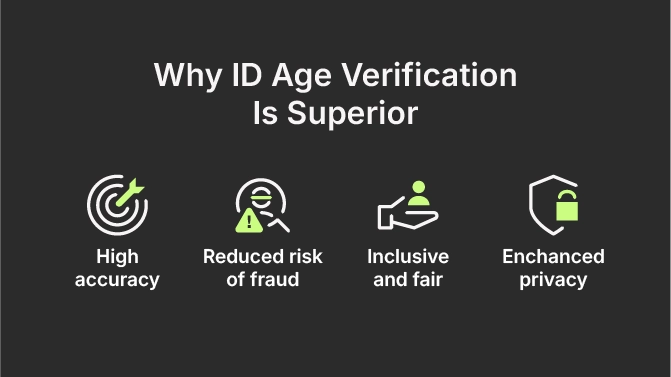
A part of a broader age verification system is ID-based age verification. In contrast with credit card age verification, it involves confirming a person’s age through government-issued identification documents, such as a driver’s license, passport, or national ID card. This age verification system addresses many of the shortcomings associated with credit card age verification.
- High accuracy. ID-based verification actually confirms who you are and how old you are, rather than making assumptions based on financial products. A government-issued ID shows your birth date directly – there’s no guessing involved. Unlike credit cards, which can belong to parents, guardians, or even be prepaid cards with minimal requirements, an ID verification check provides concrete proof of age. It’s the difference between „probably an adult” and „definitely this age”.
- Reduced risk of fraud. While credit card details can be easily shared, stolen, or passed around, ID verification creates a much tougher barrier. Modern ID verification often includes liveness checks (proving you’re a real person, not just using somebody’s photo), document authentication (confirming the ID itself is legitimate), and facial matching technology. Theoretically, of course, someone could steal an ID, but actually using it to pass verification is exponentially harder than typing in a string of credit card numbers.
- Inclusive and fair. ID verification doesn’t discriminate based on your financial status. Every adult has access to some form of government-issued identification, whether it’s a driver’s license, passport, or state ID card. You don’t need good credit, a bank account, or any particular financial standing, which means legitimate adult users aren’t accidentally locked out just because they’ve chosen to live without credit cards. Everyone gets a fair shot at access.
- Enhanced privacy. This might sound counterintuitive: how is sharing your ID more private than sharing your credit card? The key is in what gets stored and how. Reputable digital ID verification services typically don’t keep your actual ID image. They verify your age, confirm you’re legitimate, and then only store the fact that you passed verification, but not your financial information or transaction history. With credit cards, you’re handing over payment credentials that could potentially be compromised in a data breach and used for actual purchases. ID verification can be designed to extract only what’s needed (in this case – your age) without creating ongoing financial risk.
What Is Age Estimation and How It Works Online
Alongside traditional age verification systems, there’s also age estimation – a verification method that uses AI-powered facial analysis.
Age estimation analyzes facial biometric data to place users into approximate age brackets (like „under 18” or „18+”) without requiring them to upload government-issued IDs. This approach aims to balance regulatory compliance with user convenience, though it’s worth noting that accuracy can vary and the technology is still evolving.
Here are a few reasons that age estimation shines:
- Seamless verification. Traditional age verification methods, like providing IDs, can feel clunky and slow. Age estimation through facial analysis offers a smoother, faster experience, during which users just look at their camera for a few seconds, and they’re done. No need to upload photos of documents that contain sensitive information.
- Fraud prevention. Age estimation can help catch certain types of fraud when verifying a user’s age, particularly when someone tries to use a stolen ID photo or a fake document. Since the system analyzes a live face in real-time (often with liveness detection to ensure it’s not just a photo of a photo), it creates an additional layer of protection against basic workarounds. That said, it’s not foolproof, as sophisticated attempts can still slip through, and the technology works best as part of a layered approach rather than a standalone solution.
- Scalability and efficiency. AI-powered age estimation handles high volumes effortlessly. Whether you’re running a social media platform with millions of sign-ups or an e-commerce site with constant traffic, these systems can process users rapidly without creating bottlenecks. And for businesses operating at scale, that kind of speed matters.
- Cost-effectiveness. Automated age estimation cuts down on the manual labor that traditional ID checks require. No need for human reviewers to examine every document or verify every user. Once the system is set up, the marginal cost per verification drops significantly, making it an attractive option for businesses watching their bottom line.
- Privacy. Many systems don’t actually store your biometric data or personal details. Instead, they simply analyze your face, determine your approximate age bracket, and discard the image. You’re not handing over your date of birth, ID number, or any identifying documents. For privacy-conscious users and for regulators who are focused on data protection, this minimalist approach is appealing. Yet, it should be kept in mind that implementation varies by provider, so it’s worth checking exactly what data gets collected and retained.
Final Thoughts on Age Verification Methods
While credit card age verification has been a standard practice for many years, its limitations make it an inadequate solution today. The inaccuracies, potential for fraud, exclusion of legitimate users, and privacy concerns associated with credit card verification underscore the need for a more reliable method.
Meanwhile, ID age verification offers a more accurate, secure, and inclusive way to ensure that only eligible users can access age-restricted products and services. As businesses and platforms increasingly prioritize security and compliance, shifting from credit card to ID age verification is a better and necessary option.
FAQ