
Online Gambling Verification: Why It Matters


Gone are the days of signing up for an online casino with just an email. In 2025, identity verification became the gambling industry’s main defense against fraud, money laundering, and underage gambling. With global regulators watching closely, what was once a simple tick-box exercise has evolved into a sophisticated, multi-layered process that can make or break an operator’s license. From real-time identity checks to mandatory Enhanced Due Diligence (EDD) – the rules have become stricter than ever.
For players, these measures mean safer gaming and better protection against problem gambling. For operators, they represent a complex compliance challenge demanding modern technology, constant vigilance, and genuine commitment to responsible gambling. Let’s dive deeper into what online gambling identity verification involves, why it matters, and how it works.
What is Online Gambling Verification?
Online gambling verification is the process of verifying the identity and age of players who sign up to gambling sites. It typically involves a series of checks, such as verifying a player’s identity documents and checking them against databases. Some online casinos also use biometric verification methods, such as facial recognition technology, to ensure that players are who they say they are.
Identity verification in online gambling bundles several checks together because each serves a distinct legal purpose:
- Identity verification confirms you are who you claim to be (preventing fraud and multiple accounts).
- Age verification ensures you meet the legal gambling age, typically 18 or 21 depending on jurisdiction (protecting minors).
- Affordability checks assess whether you can sustain your gambling losses without financial harm (harm prevention and responsible gambling).
All three checks serve as complementary safeguards. Although you might be a verified adult, you still could be vulnerable to problem gambling, which is why regulators increasingly require all three checks. Operators must prove they adhere by the Know Your Customer (KYC) rules, that each customer is legally allowed to gamble, and that gambling won’t cause them financial distress.
Note: There is a difference between online gambling verification and casino verification.
- Gambling verification is the broad umbrella term covering all identity and compliance checks across the entire online gambling industry, such as sports betting sites, poker rooms, bingo platforms, and casino games.
- Casino verification is more specific, referring exclusively to the checks performed by online casinos. It’s a subset of the wider gambling verification process. Yet, the actual process is virtually identical: verifying identity, age, and payment methods.
In practice, the terms are often used interchangeably, and the distinction matters more for categorization than for the player experience.
The goal of verification is online gambling fraud prevention and the protection of players while also ensuring that online casinos are complying with the law. In many jurisdictions, casinos are required by law to verify the identity and age of their players, and failure to do so can result in hefty fines and even the loss of their license to operate.
In 2024, global fines in the gambling industry totaled $184.4 million, as the regulators’ vigilant scrutiny continued into 2025. The reigning champion of online gambling fines is Spain with €65.4 million issued in the first half of 2025 alone.
Why Identity Verification in Gambling is Important
First reason, naturally, is people’s safety. When the security of online gamblers is at stake, it’s paramount to ensure that players are who they say they are, and that they are legally allowed to gamble in order to prevent underage gambling and identity theft. Verifying gamblers’ identities not only helps prevent fraud, money laundering, and other illegal activities but also protects vulnerable players, such as minors and those with gambling addictions.
Second reason is heightened vigilance of the Anti-Money Laundering (AML) regulators. Thus, the UK Gambling Commission’s strengthened affordability checks now require operators to verify players’ financial circumstances before they can place certain bets. The EU’s 6th Anti-Money Laundering Package, fully implemented in 2025, demands enhanced due diligence across all member states. Meanwhile, Malta’s Gaming Authority, home to hundreds of licensed operators, has tightened its age verification requirements, mandating real-time identity checks before any deposit can be processed.
However, verifying the identity and age of players is not always easy. Unlike physical casinos, where staff can visually verify a player’s identity and age, online gambling platforms must rely on technology to meet online gambling regulations.
Online Casino Verification Process
The casino verification process follows a standardized sequence designed to confirm player identity before any real money-related activity begins. While specific implementations vary by operator and jurisdiction, the core framework remains consistent across licensed platforms. Typically, the casino verification follows the 5-stage verification process:
- Registration – Players create an account by providing basic personal information: full name, date of birth, address, and contact details. This initial data forms the baseline against which all subsequent checks are measured.
- Document and age check – Operators request government-issued ID (passport, driver’s license, or national ID card) and proof of address (utility bill, bank statement). Automated systems scan these documents to verify authenticity and confirm the player meets minimum age requirements.
- Biometric or liveness verification – To prevent identity fraud using stolen documents, many platforms now require a selfie. Facial recognition technology matches the live image against the ID photo, ensuring the person registering is the document’s rightful owner.
- Screening and approval – Behind the scenes, operators cross-reference player data against sanction lists, Politically Exposed Persons (PEP) databases, and fraud watchlists. Once all checks pass, the account receives full approval, typically within 24-72 hours, though some platforms offer instant verification.
- Periodic rechecks – Verification isn’t a one-off event. Regulators require ongoing monitoring, triggering additional checks when players request large withdrawals, change personal details, or exhibit unusual betting patterns. Enhanced due diligence may apply to high-value customers under AML regulations.
The Challenges of Online Gambling Verification
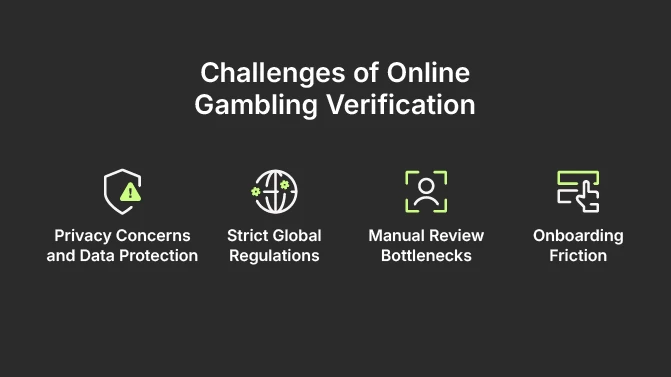
Although identity verification systems have become more sophisticated recently, implementing them effectively remains a balancing act between security, compliance, and user experience. Let’s dissect what challenges gambling operators face today:
Privacy Concerns and Data Protection
The increasing number of data breaches and identity theft incidents has scared a lot of people. Gamblers are also wary about sharing their sensitive personal information. So, handing over passport scans, bank statements, and biometric data requires significant trust, particularly when dealing with lesser-known casino brands.
Meanwhile, GDPR and similar privacy regulations add another layer of complexity: operators must not only collect data securely but also demonstrate legitimate need, ensure proper storage, and provide transparent deletion policies. And here comes the paradox – stronger verification demands more data, but demanding more data can erode player confidence (and put people off).
Onboarding Friction Dilemma
Verification processes that prioritize security often sacrifice speed and simplicity. Asking new players to upload multiple documents, wait for manual review, and complete liveness checks before their first bet can kill not only their desire to place bets, but also conversion rates.
A slow or complicated onboarding process causes high drop-off rates, with players leaving before completing registration, particularly with recreational players who expect instant gratification. Competitors with lighter verification may poach these frustrated users, creating a competitive disadvantage for compliance-focused operators. The industry constantly grapples with this tension: How strict is too strict before legitimate players abandon the process entirely?
Manual Review Bottlenecks
Many operators still rely on human reviewers to verify documents, particularly for edge cases or suspicious submissions, thus creating predictable delays, as verification queues that stretch 24-48 hours during peak periods, leaving eager players in limbo. Manual review is also expensive, inconsistent, and doesn’t scale efficiently. Not to mention that one reviewer might approve a document and another would reject it, introducing subjectivity into a process that should be objective. Weekend and holiday backlogs compound the problem further, turning what should be a seamless experience into a frustrating waiting game.
Global Regulations Maze
No two jurisdictions approach gambling verification identically. The UK Gambling Commission has implemented financial risk checks, aka affordability checks, that began as a pilot in August 2024 at a £500 monthly net deposit threshold, dropping to £150 per month from February 2025. These checks use credit reference data to identify financially vulnerable players, introducing a level of scrutiny that simply doesn’t exist in many other jurisdictions.
Malta’s MGA mandates comprehensive testing of gaming software and requires operators to ensure their systems are secure, reliable, and transparent, while Curaçao lacks mandatory independent testing requirements. Gibraltar enforces strict AML and Counter-Terrorist Financing (CFT) regulations with comprehensive audits, whereas Curaçao relies on individual operators to manage disputes, often leading to inconsistent outcomes.
For operators serving multiple markets, this creates a true compliance nightmare: building flexible systems that adapt verification requirements based on player location without creating loopholes or discriminatory practices. For example, an operator licensed in Malta who wants to accept UK players must implement the UK’s stringent affordability checks, while their Curaçao-licensed competitor targeting different markets faces far lighter requirements. And the cost of getting it wrong? License suspension or hefty fines!
Solutions for Online Gambling Verification
Despite these challenges, there are a number of solutions being developed to address the issue of gambling verification.
The strongest of which is AI-based solutions that can verify document authenticity in seconds, detect deepfakes and manipulated images, cross-reference data across multiple sources, and flag high-risk applications for human review, all while processing thousands of applications simultaneously. AI-powered systems can achieve consistency that human reviewers cannot, applying the same standards to every submission regardless of workload or time of day.
Early adopters are already seeing dramatic improvements: verification times dropping from days to minutes, false positive rates declining, and operational costs plummeting. As AI technology matures and regulatory acceptance grows, automated verification may finally solve the industry’s oldest tension, keeping bad actors out while letting legitimate players in without friction.
How can Ondato Help?
The gambling industry operates under intense regulatory scrutiny, where knowing your customers is the law. Ondato’s digital identity verification platform transforms compliance from a bottleneck into a competitive advantage, delivering fast, secure, and regulation-proof verification that keeps both regulators and players satisfied.
Our document verification and biometric identification solutions cut through the complexity: verify a player’s identity in seconds, then use facial recognition technology to confirm the person holding the ID is genuinely the account holder. No impersonators, no fraudsters, no sleepless nights. Ondato helps gambling operators slam the door on fraud, money laundering, and illicit activity, while creating a smoother onboarding experience that converts more legitimate players.
Regulations never stand still, but Ondato’s verification process evolves with them. With years of hands-on AML compliance experience, we’ve mastered the art of navigating shifting regulatory landscapes. We also recognize that no two operators face identical challenges: whether you’re a startup casino or an established betting platform, our identity verification solutions adapt to your specific requirements and risk profile.
Finally, speed matters in an industry where frustrated players abandon lengthy verification processes. Ondato delivers verifications in as little as 30 seconds, eliminating the „queue anxiety” that costs operators their customers. By maintaining the highest anti-money laundering compliance standards (robust enough for banks and financial institutions), we offer specialized age verification systems tailored specifically for gambling sites.
The Future of Gambling Verification
What once was a regulatory formality, evolved into a critical foundation of industry integrity. Online gaming verification protects vulnerable players, prevents fraud and money laundering, and ensures operators maintain their licenses in the increasingly scrutinized and regulated gambling industry.
Looking ahead, it seems like the verification „arms race” will intensify. Regulators will demand faster, more accurate checks without compromising player experience. AI and machine learning will become standard, replacing manual reviews with instant, intelligent screening. And biometric authentication will grow more sophisticated, making identity fraud nearly impossible.
The operators who thrive won’t be those who treat verification as a burden, but those who embrace it as a competitive advantage. Because building trust, converting more players, and staying ahead of compliance curves is the only road to survival.
FAQ