Know Your Patient (KYP): What It Is and Why It Matters in Healthcare
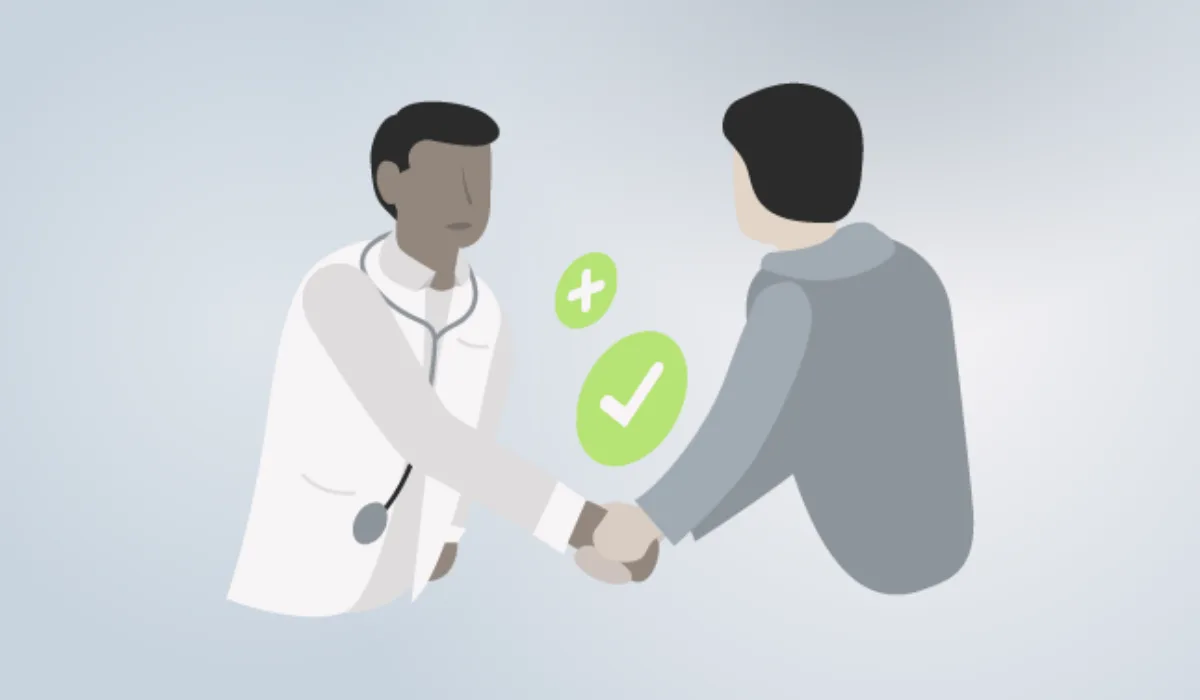

Similar to other industries, healthcare has become increasingly digital. The era of clipboards and paper medical IDs has come to an end, as these methods can no longer effectively protect people’s personal data. Akin to the financial industry’s Know Your Customer (KYC), in healthcare – it is Know Your Patient (KYP) that is taking center stage.
KYP is the framework that ensures that when a patient walks into a clinic or logs into a health-related portal, they are exactly who they claim to be, before they’re even registered, treated, billed, prescribed, or given access to protected health information. In other words, KYP is a way to prevent medical identity theft, secure sensitive data, and, ultimately, save lives.
Let’s take a closer look at what KYP is, why it’s critical in healthcare, and how it works.
What Is Know Your Patient (KYP)?
Know Your Patient is the process that healthcare providers use to verify a patient’s identity before they access medical services, records, or prescriptions.
Practically speaking, healthcare providers check people’s IDs, biometrics, or records to confirm they are real, much like banks do with KYC to stop financial scams – but here it’s about your health history, not your bank account. by someone else’s data.
Unlike financial KYC, KYP stops “healthy laundering” by ensuring that a patient’s medical history remains accurate and isn’t contaminated. The Know Your Patient process is designed to:
- Facilitate patient identification,
- Ensure patient safety (the right patient gets the right care),
- Protect record integrity (no “mixed” charts),
- Prevent insurance fraud,
- Guarantee confidentiality of physical health information.
EXAMPLE: A fraudster uses a patient’s identity, resulting in “No known allergies” being falsely recorded in their medical file. Without KYP, your staff might unknowingly administer penicillin to the patient, leading to a life-threatening reaction and a devastating medical malpractice claim. KYP acts as a safeguard, ensuring the data you rely on is accurate and protecting your practice from severe clinical errors.
Why Identity Verification Is Critical in Healthcare
Healthcare is, by far, one of the most targeted industries for identity fraud and data breaches.
The main reason is that medical records are extraordinarily valuable. While a stolen credit card can be cancelled, a stolen medical record cannot. It contains the patient’s name, date of birth, Social Security number, insurance details, prescription history, and more. In other words, a medical record is a complete package that criminals can use for multiple types of fraud simultaneously. And that can cause a lot of trouble to healthcare providers.
So, when identity controls are weak, healthcare risks tend to show up in very real ways: medical identity theft, insurance/billing misuse, record mix-ups, and unauthorized access and breaches.
- Financial impact. According to the IBM 2025 Cost of a Data Breach Report, healthcare has remained the costliest industry for a breach for the 14th consecutive year. While the global average cost of a healthcare breach sits at $7.42 million, record-breaking regulatory fines and detection costs in the United States have pushed the average cost of a US breach across all sectors to a staggering $10.22 million per incident.
- Medical identity theft. The FTC in the US defines medical identity theft as someone using personal information, such as a name, Social Security number, or Medicare/insurance number, to get care, obtain prescriptions, buy medical devices, or submit insurance claims. If a fraudster’s (thief’s) health information gets mixed into the patient’s record, it could affect the care or benefits the real patient can receive.
- Prescription and insurance fraud. Without proper patient verification, individuals can attempt to obtain controlled substances using falsified or stolen identities. This is a known driver of prescription opioid misuse. And when someone else uses your insurance benefits, your coverage can be exhausted, your records altered, and your future claims denied, even when you’re seeking entirely legitimate care.
- Data breaches. Breaches don’t just expose data – they can also create a cascading identity theft factory when patient identifiers leak once and get reused elsewhere. Weak identity controls at the point of entry create vulnerabilities that ripple throughout the entire health system. Around 95% of all identity theft incidents reportedly originate from compromised healthcare records, making patient data the richest target in the identity theft ecosystem.
- Patient safety. When data is compromised, patients’ safety is at risk. If a fraudster’s blood type or chronic condition is added to a patient’s electronic health record, the clinical decisions made for them are based on a lie.
In the US alone, medical identity theft costs an estimated $41.3 billion annually, with the average out-of-pocket cost to individual victims reaching $13,500 per incident. Source
Every patient trusts their healthcare provider with their most sensitive personal information. That’s why strong Know Your Patient practices are mandatory means for healthcare organizations to honor that trust.
Is Know Your Patient Legally Required?
Even though, technically speaking, KYP is not a legal obligation as there is no such law as “The KYP Act”, the key requirements are woven into the fabric of the global healthcare regulation, such as:
- HIPAA: The HIPAA Privacy Rule specifically requires covered entities to implement “reasonable policies and procedures to verify the identity” of any person requesting protected health information.
- HITECH Act: This promotes the adoption of electronic health records, carrying strict mandates for access controls and identity management to ensure data confidentiality and integrity.
- The Red Flags Rule: Enforced by the FTC, this requires healthcare providers to have programs in place to detect the “red flags” of identity theft in their day-to-day operations.
- GDPR: This law supports Know Your Patient practices by embedding identity verification as a safeguard for protecting personal data, especially in healthcare where sensitive health information is at stake.
How the KYP Process Works in Practice
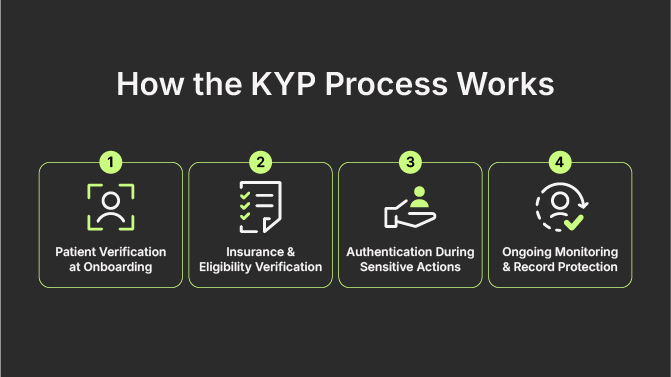
KYP is a complex process that operates at multiple touchpoints throughout a patient’s journey. Let’s go deeper into how it typically works.
Patient Identity Verification at Onboarding
The first point of verification happens at registration, whether that’s in person at a clinic or through a digital onboarding flow.
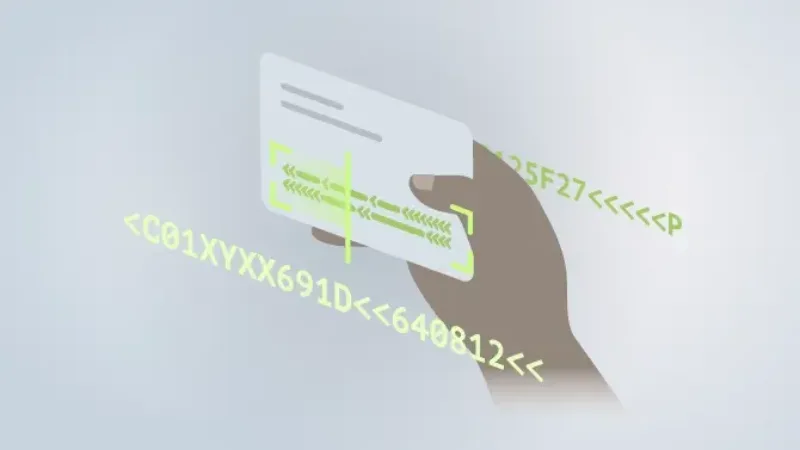
In-person registration: A patient presents a government-issued photo ID (a driver’s license or passport), along with insurance documentation and any other relevant personal identifiers. A staff member checks the documents against the information provided and creates the patient record.
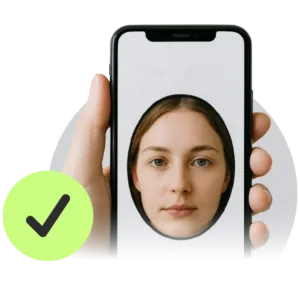
Digital onboarding: Using a smartphone, a patient takes a photo of their government-issued ID and uploads it into a system. Then they are asked to take a matching selfie, which is backed by a liveness check to prevent hackers from using a static photo to bypass security. With AI-driven fraud attempts like deepfakes surging by 2,137% over the last three years, modern onboarding systems now use liveness detection to ensure a real person is present.
The digital identity verification process involves:
- document verification (uploading images of ID documents),
- database validation (cross-referencing the details against authoritative records),
- biometric authentication.
Only once this process is complete does the patient gain access to book appointments or view any records.
Insurance and Eligibility Verification
Alongside identity, healthcare providers verify that a patient’s insurance coverage is active, accurate, and applicable to the services that are requested.
This step involves checking the patient’s insurance ID number, confirming their plan details with the insurer in real time, and flagging any discrepancies, such as a name mismatch between the identity documents and the insurance card.
This step protects the provider from delivering care that won’t be reimbursed and catches fraudulent use of another person’s insurance before any harm is done. A patient who presents with an insurance card that doesn’t match their verified ID is a clear red flag and subject to further review. Such checks reduce “claim-and-run” fraud, in which someone uses a friend’s or family member’s insurance card.
Authentication During Sensitive Actions
Identity verification doesn’t stop at onboarding, though. High-risk actions, such as accessing detailed medical records, requesting controlled medications, or joining a telehealth consultation, should trigger re-authentication.
Similar to Multi-Factor Authentication (MFA), when logging into a patient portal a patient may need to enter a password and then confirm it with a code sent to their phone number. For telehealth appointments, some providers require patients to complete a short identity check at the start of each session. For prescription requests, pharmacies may verify the patient’s identity before dispensing controlled substances, particularly if the request came through a digital channel.
For example, the US Health Insurance Portability and Accountability Act (HIPAA) Security Rule explicitly requires covered entities to implement authentication controls for web portals that provide access to protected health information (PHI). Put simply, re-authentication is not optional.
Ongoing Monitoring and Record Protection
The final stage of the KYP process is safe data storage; i.e., maintaining ongoing vigilance over how patient records are accessed and used.
A healthcare organization needs to keep detailed logs of every time a patient record was accessed, by whom, and from where. It means monitoring for unusual patterns, such as a single account accessing hundreds of records in a short period, or a patient record being accessed from an unfamiliar location.
All this means that there should be clear processes in place that would allow healthcare companies to act quickly when something suspicious is flagged.
This kind of continuous monitoring is a standard feature of well-designed healthcare compliance programs. It’s also the mechanism that helps organizations catch insider threats; for example, when employees misuse patient information.
Insider breaches, involving healthcare employees misusing patient information, account for approximately 15% of medical identity theft incidents. Source
7 Common Gaps in Healthcare Identity Verification
Despite the fact that the KYP process clearly brings a lot of benefits to healthcare institutions, there are still a number of weak spots that obstruct the implementation:
- Over-reliance on static identifiers
Many healthcare systems still rely on date of birth, address, and the last four digits of a Social Security number as their primary verification method. However, these static identifiers are easy to find, especially given the scale of today’s data breaches. Moreover, inaccurate, incomplete, or inconsistently formatted demographic data can make record matching difficult, leading to safety and privacy consequences. - No biometric verification
Biometric checks, such as facial matching and liveness detection, significantly raise the bar for fraudulent onboarding. Yet, many healthcare providers, particularly smaller practices, have not adopted them. - Weak re-authentication
A single login that remains active for hours, shared devices, or “password-only” access for sensitive tasks increase the risk of unauthorized access. Moreover, a patient might be carefully verified at onboarding, but then face no identity check when they later access their records, request a prescription refill, or join a telehealth session. This creates a gap that criminals can exploit. That’s why NIST’s guidance calls for reauthentication and recommends phishing-resistant options, given that phishing is a significant threat. - Human error and inconsistent training
KYP processes are only as strong as the people executing them. So, the staff, especially busy front-desk employees, who may be unfamiliar with verification protocols, under time pressure, or simply unaware of the risks, can inadvertently bypass important controls. Also, simple typos, names entered in the wrong fields, or missing apartment numbers – as small as these issues may sound, they can still create big problems. - Insufficient post-onboarding monitoring
Many healthcare organizations focus their identity controls at the front door and neglect ongoing monitoring. Without audit trails and anomaly detection, fraudulent activity can continue undetected for weeks or months. That’s why HIPAA requires audit controls to record and examine activity in systems that contain or use electronically processed protected health information. - Siloed systems
When patient records, insurance data, and prescribing systems don’t communicate effectively, it becomes harder to build a complete picture of a patient’s identity, and easier for inconsistencies to slip through. - Ransom pressure
Ransomware can disrupt care and expose patients’ data that, inadvertently, fuels identity fraud. In 2025, there were 445 registered ransomware attacks on direct healthcare providers, like hospitals and clinics – up 2% from 2024; plus 191 on related businesses, like pharma and billing – a 25% increase. To counter this serious problem, the US’s HIPAA Security Rule measures, such as risk analysis, malicious software protections, training, and access controls, are there to prevent ransomware attacks.
Healthcare organizations spend, on average, just 7% of their IT budgets on cybersecurity, which is below the cross-industry average of 9.9%. Source
Manual vs. Digital Patient Verification
The gap between traditional and modern identity verification methods is widening, as healthcare becomes more digital. Here is how they compare.
| Feature | Manual / In-Person Verification | Digital Identity Verification |
|---|---|---|
| Speed | Slower; relies on staff availability and document handling | Faster; can complete in minutes without staff involvement |
| Scalability | Difficult to scale, constrained by staff capacity | Highly scalable, can process large volumes simultaneously |
| Accuracy | Prone to human error, inconsistent application of procedures | More consistent, automated checks reduce subjective judgement |
| Fraud detection | Limited, relies on staff spotting discrepancies visually | Enhanced; can cross-reference databases, detect document tampering, and flag anomalies |
| Biometric capability | Rarely used; typically limited to visual comparison | Can include facial matching, liveness detection, and document authenticity checks |
| Audit trail | Manual records, variable quality and completeness | Automated, timestamped logs, easier to review and audit |
| Patient experience | Can feel slow or intrusive, especially at busy clinics | Generally faster and can be completed remotely before an appointment |
| Cost | Lower upfront cost, higher ongoing staff cost | Higher upfront investment, lower ongoing cost at scale |
| Regulatory alignment | Meets baseline HIPAA requirements in most cases | Better positioned for stricter future requirements and telehealth expansion |
All this shows that digital patient verification is not about replacing human judgment entirely, as there are situations, particularly in emergency care, where rigid verification procedures must be set aside in the patient’s interest.
But for standard onboarding, remote consultations, and record access, digital verification is a more efficient and secure option that offers consistency, scalability, and fraud-detection capabilities that manual processes simply cannot match.
As healthcare data breach statistics continue to climb year on year, the case for investing in modern, layered KYP processes becomes obvious. Know Your Patient is steadily becoming a part of the essential infrastructure for the healthcare organizations that take patient safety and data protection seriously.
FAQ