
Identity Spoofing: Modern Threats to Identity Verification
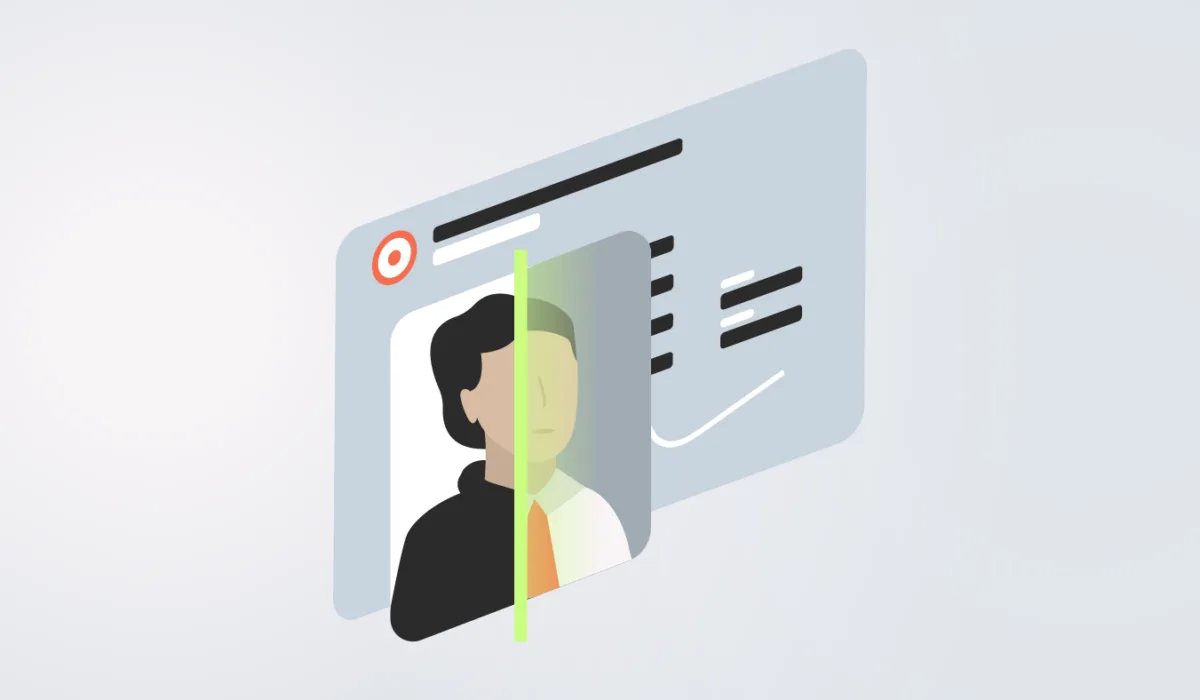

A convincing identity used to require stolen documents, specialist equipment, and considerable effort. Today, a fraudster may only need leaked personal data, an image from social media, and readily available artificial intelligence tools.
This is the challenge identity spoofing creates for modern, law-abiding organizations. Unlike before, today’s fraudsters no longer rely on obviously forged documents or stolen passwords. Instead, they can combine leaked personal data, manipulated identity documents, synthetic profiles, deepfake videos, and compromised devices to create an identity that appears convincing at every step.
For companies onboarding customers or providing access to financial services, verifying whether identity information is only the first step, as they also must determine whether the person presenting that information is real, present, authorized to use it, and behaving like a legitimate customer.
In this article, we will review all aspects of identity spoofing, its types, impact on the spread of financial crime, how your organization can mitigate risks, and what the future holds.
Why Identity Spoofing Is Becoming a Growing Challenge
The definition of Identity Spoofing states that it is a crime that happens when someone manipulates or misuses identity information to impersonate another person or to create a believable identity that does not belong to a real person.
And while the idea is not new, what has changed is how quickly, cheaply, and convincingly it can now be done.
However, one thing is painfully obvious: the financial impact of this crime is very substantial. According to the US Federal Trade Commission, consumers reported losing $3.5 billion to imposter scams in 2025, which is nearly 3x the amount reported in 2020.
Here are three main reasons why identity spoofing has turned into a serious headache.
Reason 1. More customers are verified remotely
Remote or digital onboarding has made it possible for customers to open accounts, access services, and complete identity checks without visiting a physical location.
While it’s convenient for customers and essential for digital businesses, it also means that organizations must make trust decisions using information submitted through a screen.
A fraudster may be able to:
- Purchase stolen personal information
- Alter the photograph on an identity document
- Generate a matching face or video
- Hide behind a proxy or compromised device
- Repeat the process across several organizations
Each element may appear plausible when reviewed separately. Yet, the real danger appears when they are combined into one convincing application.
Remote identity proofing includes such threats as: manipulated documents, printed photographs, screen replays, masks, video attacks, and other attempts to fool remote facial-verification systems.
Reason 2. AI has lowered the barrier to entry
Gone are the days when creating a convincing fake identity required advanced editing skills and specialist knowledge. With the arrival of Generative AI, many of those “special’ capabilities have become easy to access.
Nowadays, fraudsters can use AI tools to generate realistic faces, modify identity documents, clone voices, and produce videos that imitate a real person. More so, they can create several consistent images of the same synthetic person – something that is useful when an onboarding process requests multiple photographs or angles.
In 2024, the US Financial Crimes Enforcement Network said it had observed a sharp increase in suspicious activity reports describing the suspected use of deepfake media during 2023 and 2024.
A fake does not need to be flawless. It only needs to be convincing enough to pass the controls placed in front of it.
In 2025, the FBI received more than 1 million cybercrime complaints and nearly $21 billion in reported losses. AI-related complaints alone accounted for almost $893 million. Source
Reason 3. Stolen data gives fraudsters a head start
Many spoofing attempts are built around genuine information. Names, dates of birth, addresses, identity numbers, passwords, document images, and account details can be obtained through phishing attacks, malware, data breaches, or social engineering.
This creates an important problem: a verification check can confirm that the information belongs to a real person while still failing to establish that the applicant is actually that person. In other words, the data may be correct, but the user may still be a fraudster.
Modern Identity Spoofing Techniques

Identity spoofing is a collection of techniques that can target documents, biometrics, personal information, accounts, and the verification process itself.
Let’s analyze the most common spoofing scam techniques that criminals use:
Stolen or manipulated identity documents
A fraudster may use:
- a genuine document stolen from another person,
- a real document with an altered photograph or personal details,
- a fabricated document designed to resemble an official one,
- a digital copy, screenshot, or printout presented as an original document.
Now, let’s visualize this.
First, a fraudster obtains a photograph of someone’s passport from a compromised email account. The passport is genuine, and all the information on it may match authoritative records. The criminal only needs to replace or digitally manipulate the portrait to make the document appear to belong to them.
A system that checks only the document’s data may approve the application. But a stronger identity verification process also asks whether the document is authentic, whether it has been altered, and whether the applicant is its rightful owner.
Synthetic identities
A synthetic identity combines real and invented information.
For example, a fraudster might use a genuine government-issued identification number with a fabricated name, a newly created address, an AI-generated portrait, and an email account controlled by the attacker.
Rather than immediately committing a large fraud, the attacker may slowly build a history for the identity. For example, they can open a low-risk account, make small payments, and demonstrate apparently normal behavior. Once the identity looks trustworthy, it can be used to apply for larger credit sums or access higher transaction limits.
Synthetic identities are especially challenging because there may be no single person who recognizes the complete identity and reports it as stolen.
Biometric spoofing
Biometric spoofing targets checks that use a face, voice, fingerprint, or another biological characteristic to verify a person.
Facial spoofing methods can include:
- Holding a printed photograph in front of a camera.
- Displaying a photograph or video on another screen.
- Using a prerecorded video of the victim.
- Wearing a physical mask.
- Applying a real-time face swap.
- Injecting manipulated video directly into the verification process.
A stronger identity verification process asks an applicant to blink and turn their head. While, a printed photograph may fail that challenge, a prerecorded video could pass it. So, a real-time deepfake may go further by responding to instructions during the session.
That is why basic movement checks should not automatically be treated as strong proof of life.
Account takeover and recovery abuse
However, spoofing does not stop after a customer has been onboarded, as fraudsters also impersonate legitimate users to gain control of existing accounts.
An attacker might call customer support, provide the customer’s stolen personal information, and claim to have lost access to their phone. They could use a cloned voice or manipulated video to appear more convincing.
If the support agent resets the customer’s authentication methods, the attacker gains access to an account that has already passed identity verification.
Account recovery, password resets, changes to personal details, and replacement of authentication devices should therefore be treated as identity-risk events!
Device and channel manipulation
Some spoofing attacks target the route through which identity information reaches the organization.
This means that instead of placing a fake image in front of a real camera, an attacker may use:
- A virtual camera.
- An emulator.
- A modified mobile application.
- A compromised device.
- An injected video stream.
- Remote-access software.
This matters because a liveness detection cannot provide much confidence if the verification system cannot trust the camera feed it is receiving.
How Identity Spoofing Enables Financial Crime
The final goal of many criminals is not just to pass identity verification, but open the door to another crime possibility.
Account-opening fraud
This is the most wide-spread use of identity spoofing. False, stolen, or synthetic identities can be used to open:
- Bank or payment accounts.
- Credit accounts.
- Cryptocurrency accounts.
- Merchant profiles.
- Loan applications.
- Money-mule accounts.
Once approved, these accounts may receive scam proceeds, process unauthorized payments, obtain credit, or move money on behalf of another criminal.
For example, a fraudster could apply using a stolen identity document and an AI-generated video based on the document photograph. After the account is approved, it starts receiving payments from unrelated fraud victims and quickly transfers them elsewhere.
The identity-spoofing attack has now enabled both account-opening fraud and the movement of criminal proceeds.
Money laundering
Identity spoofing helps criminals create distance between themselves and illicit funds.
Accounts opened under stolen identities, synthetic profiles, recruited money mules, or front companies can be used to receive, divide, transfer, or convert criminal proceeds. Several accounts may be connected to create layers of transactions that make the true source and controller of the money harder to identify.
The gravity of the problem is also backed by statistics:
- According to the US Financial Crimes Enforcement Network, only in 2021, approximately 1.6 million Bank Secrecy Act (BSA) reports were related to identity issues. Those reports represented 42% of all reports filed that year and described approximately $212 billion in suspicious activity.
- According to FinCEN financial trend analysis, approximately 323,000 reports, which is 13% of identity-related filings, described attackers exploiting insufficient verification processes.
The KYC blind spots
A typical Know Your Customer (KYC) process may confirm that an identity document follows the expected format, the personal information matches a database, and that the identity belongs to a real person.
Yet, none of these checks automatically proves that the applicant owns the identity.
A strong process needs to answer several different questions:
- Does this identity exist?
- Is the evidence authentic?
- Does the applicant own the identity?
- Is a real person participating in the process?
- Does the customer’s behavior make sense afterward?
An organization that answers only the first question may successfully verify the victim’s identity while onboarding the attacker. So, it’s not enough.
You need to assess digital identities through a risk-based approach, including their assurance levels, reliability, independence, and suitability for Customer Due Diligence (CDD).
How Organizations Detect and Mitigate Identity Spoofing

There is no single check that can stop every identity-spoofing attempt. The most resilient approach is layered: one control detects what another may miss.
Build verification in layers
Depending on the customer, product, and level of risk, an identity-verification process may combine:
- Document verification to assess whether identity evidence is genuine and unaltered.
- Data verification to compare identity information with authoritative or credible sources.
- Biometric comparison to determine whether the applicant resembles the document holder.
- Liveness and presentation-attack detection to establish whether a real person is participating.
- Device and network checks to identify suspicious devices, emulators, proxies, or repeated applications.
- Behavioral and transaction monitoring to identify activity that does not match the customer’s expected profile.
- Manual review when automated signals are unclear or contradictory.
The goal is not to collect as many signals as possible, but rather to collect signals that independently answer different questions about identity.
Look beyond the visible document
Document verification should examine more than whether the document looks convincing to the human eye.
Relevant checks can include:
- Document layout and template consistency.
- Machine-Readable-Zone (MRZ) validation.
- Barcode or QR-code comparison.
- Security-feature inspection.
- Signs of digital editing or image replacement.
- Comparison with trusted data sources.
- NFC-chip reading for supported electronic identity documents.
Most importantly, the document should be connected to the person presenting it.
Combine liveness with capture-channel security
Liveness detection can help identify photographs, video replays, masks, and other presentation attacks. However, it should be paired with controls that assess how the image or video entered the system.
Organizations should consider two separate questions:
- Is the person or object in front of the camera genuine?
- Can the organization trust the camera feed itself?
For example, the ENISA Remote Identity Proofing Good Practices report expands the focus beyond traditional presentation attacks to include newer threats and wider ecosystem risks, such as the use of virtual cameras, emulators, deepfake software, and injected media.
Apply stronger checks when the risk increases
By all means, not every interaction needs the same level of friction.
A low-risk account with limited functionality may require fewer checks than an account that can immediately transfer large sums of money. Stronger verification or step-up controls may be appropriate when a customer:
- Requests higher transaction limits.
- Changes verified identity information.
- Adds a new payment beneficiary.
- Resets authentication methods.
- Logs in from a suspicious device or location.
- Initiates unusual cross-border activity.
- Applies for a higher-risk product.
- Appears connected to several other identities.
A risk-based approach makes verification more effective without forcing every legitimate customer through the most demanding possible process.
Keep monitoring after onboarding
This is one of the most important pieces of advice any organization should take onboard –identity verification should not end when an account is opened.
A customer may pass every onboarding check and still behave suspiciously afterward. A newly opened account that immediately receives funds from several unrelated people and transfers the money elsewhere deserves attention, regardless of how convincing the original application appeared.
Organizations should connect identity verification results with transaction monitoring, account-takeover alerts, customer-support activity, chargebacks, and confirmed fraud cases. This creates a feedback loop: when an attack succeeds, the organization can identify which signals were missed and strengthen the relevant controls.
Future Trends in Identity Spoofing
Identity spoofing is likely to become faster, more interactive, and more difficult to recognize visually. So, businesses should stay alert, know what the future holds, and proactively prepare for future challenges.
Deepfakes Will Move from Prerecorded to Real-Time
Organizations should expect more fraud attempts involving faces and voices that react during live conversations.
A fraudster may be able to join a video call, answer questions, turn their head, and speak using another person’s appearance and voice. This may eventually weaken controls that rely heavily on a reviewer simply deciding whether someone “looks real”.
FinCEN has already warned financial institutions that generative AI can be used to create or alter identity documents and other media to bypass verification and authentication controls in its alert on deepfake media targeting financial institutions.
Attackers Will Target the Entire Identity Journey
Future attacks will not focus only on onboarding. They will also target:
- authentication,
- account recovery,
- customer support,
- transaction approval,
- changes to personal information,
- high-risk account actions.
Organizations will need consistent identity controls across the customer lifecycle. A strong onboarding process offers limited protection if a fraudster can later bypass it through a weak password-reset or support procedure.
Fraud Attempts Will Become More Automated
AI can help attackers generate identity profiles, modify supporting documents, communicate with victims, and quickly test variations of an application.
This means organizations may face not only better fakes, but more of them. A fraudster who previously submitted a handful of applications may be able to launch hundreds of tailored attempts and learn from every rejection.
Defenses must therefore be able to not only not only assess each application in isolation, but also recognize patterns across accounts, devices, documents, networks, and behavior.
Biometrics Will Remain Useful, but They Cannot Stand Alone
Biometrics can provide valuable evidence that the same person is present during different interactions. But a face or voice is not automatically proof of identity.
Biometric checks need protection against presentation attacks, replay, deepfakes, injection, and stolen biometric data. They should be used as one part of a layered process rather than as an unquestionable source of truth.
Independent evaluation can help a lot here. Thus, NIST’s Face Analysis Technology Evaluation for presentation-attack detection assesses how well algorithms detect different spoofing instruments and attack conditions.
Final Thoughts
Identity spoofing takes advantage of a simple gap – information can be correct even when the person using it is not legitimate.
That is why modern identity verification must do more than confirm that a document exists or that personal information matches a record. It must connect the identity, the evidence, the applicant, the device, and the customer’s behavior into one coherent picture.
For organizations evaluating their approach, the priorities are clear:
- Authenticate identity evidence.
- Establish that the applicant owns it.
- Detect presentation and injection attacks.
- Apply stronger controls when risk increases.
- Monitor identity risk throughout the customer lifecycle.
Fraudsters will continue adapting their methods. Organizations do not need to predict every new trick, but they do need an identity verification strategy that can adapt when the next one appears.
FAQ


