
France’s Social Media Ban: A Turning Point for Age Verification in Europe?
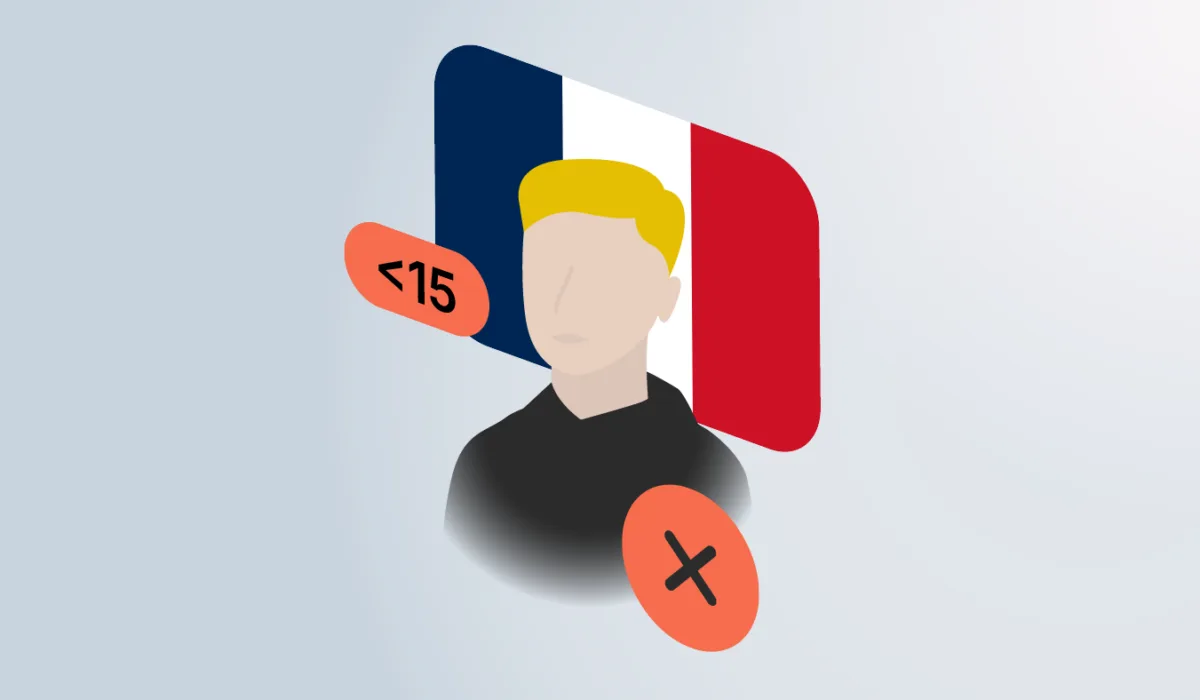

On July 21, 2026, France became the first EU country to ban social media access for children under 15 – a move President Emmanuel Macron called a major step for protecting children and teenagers.
Even though the headline is national, the story underneath it is not. France’s ban lands in the middle of a much bigger European shift toward stronger, more verifiable proof of age, backed by new digital identity infrastructure and tightening enforcement of the EU’s Digital Services Act (DSA).
Across Europe, regulators are connecting child safety, platform design, age assurance, privacy, and digital identity into one evolving compliance picture. This shift poses a challenge for businesses: to build age controls that are effective, proportionate, easy to use, and ready to adapt as national and EU requirements develop.
This article looks at what France’s law actually does, why it’s part of a wider regulatory pattern, and what it means for any business that verifies age or identity online.
France’s Social Media Ban: Key Facts
France’s law adds a new provision to the country’s 2004 digital economy statute, prohibiting minors under 15 from accessing online social network services.
It applies to platforms like TikTok, Instagram, and Facebook, with narrow carve-outs for online encyclopedias, educational and scientific directories, and open-source software platforms used for teaching.
The ban enforcement takes effect in stages:
- The law was passed on July 21, 2026, by the French National Assembly and Senate.
- On July 23-24, 2026, the law was referred to France’s Constitutional Council for a constitutional review.
- The law becomes fully legal on September 1, 2026, and any existing accounts belonging to children under 15 must be closed by January 1, 2027.
At this point, we should pay attention to an important detail of the new law: the final version states the age restriction, but it does not prescribe a specific French age-checking technology or retain the proposed enforcement role for France’s media regulator, Arcom. The French Parliament removed those provisions after the European Commission raised concerns about overlap with EU law. In practice, implementation is expected to sit largely within the EU’s Digital Services Act framework.
This means that the French social media ban does not tell businesses exactly how compliance will work, leaving the important question: What evidence should a service request to establish that a user is old enough, and how can it do so without collecting more personal data than necessary?
In other words, a national ban on paper is already dependent on a European framework in practice. This is a pattern worth monitoring as other countries consider similar rules.
What Is Driving Stricter Age Verification Requirements?
As we’ve already established, this law didn’t come out of nowhere.
The first driver sits on the surface: self-declared dates of birth are easy to bypass.
A 2025 Arcom study of 2,000 French children aged 11 to 17 found that 44% had started using at least one social network before age 13. It also found that 62% had lied about their age when registering, while fewer than one in five had faced an age check.
Those figures help explain why regulators increasingly view a simple “enter your birthday” field as weak evidence rather than meaningful age assurance.
The second driver is people’s concern about children’s exposure to harmful content, sexual exploitation, unwanted contact, cyberbullying, manipulative commercial practices, and engagement features designed to keep users online.
According to France’s health and safety watchdog, ANSES, 90% of children between 12 and 17 use a smartphone daily to access the internet, 58% of them specifically for social networks, and about one in two teens spends between 2-5 hours a day on their phone.
ANSES has recommended that minors should have access only to social networks designed and configured to protect their health. At the EU level, the European Commission’s guidelines on protecting minors under the Digital Services Act address private-by-default accounts, safer recommender systems, stronger reporting tools, limits on addictive design, and effective age assurance.
Finally, mental health concerns are a big part of this policy discussion. ANES concluded that while social media isn’t the sole cause of declining teen mental health, its negative effects, including anxiety, lower self-esteem, and higher exposure to content related to self-harm and eating disorders, are well-documented, with girls, LGBTQ+ youth, and teens with existing mental health conditions being most affected.
Problematic social media use among adolescents rose from 7% in 2018 to 11% in 2022. Source
France isn’t acting in isolation. The European Parliament called on the EU to establish minimum ages for social media access back in November 2025, and several member states have been watching Australia’s under-16 social media ban, which took effect in December 2025, as an early test case.
Business Implications for Digital Platforms and Online Services

For any digital business, the practical question today is whether its sector falls under the same growing expectations for reliable age checks.
Let’s review the main implications social media bans, like France’s, have on modern digital businesses.
Age assurance becomes part of product design
Age verification can no longer be treated as a legal notice added at the end of the customer onboarding. Today, it affects account creation, permissions, content access, recommendations, messaging, payments, advertising, parental controls, and customer support.
For example, if a service allows users to watch content, join public groups, and message strangers. It may need different controls at different points. A low-risk browsing experience could require no age check. Joining a public community might require an age range. Accessing an adult-only area could require stronger proof.
The right approach is usually risk-based.
Customer experience becomes a compliance issue
Every extra onboarding step can reduce completion rates and negatively affect customer experience. At the same time, a weak age gate can create regulatory and reputational risk.
Therefore, the goal is not to impose maximum friction or minimum friction, but rather – appropriate friction. A user should understand why an age check is happening, what information is needed, how it will be used, and what alternatives exist if the check fails.
For example, asking every adult to upload an identity document just to prove they are over 15 may be excessive. A privacy-preserving credential that returns only “over 15: yes” can meet the business need with less data exposure.
Businesses may need to verify age without identifying the user
This distinction is central to the future European model.
Identity verification helps establish who the person is, while age verification establishes whether the person meets the relevant age threshold. And for that, the platform may not need the user’s name, exact birth date, address, or document number.
This principle is the cornerstone of the European Commission’s age-verification solution, by which a user certifies their age through an accepted source, then shares a limited proof such as “over 18: true”. For example, the Commission’s technical FAQ states that the app is designed to store the age result without the person’s name or birth date.
This is an example of an attribute-based digital identity: prove the fact that matters, not the entire identity behind it.
Operations must support exceptions and evidence
However, automated age checks will not work perfectly for every user. That’s why businesses will need to have fallback routes for people without compatible documents, users with accessibility needs, false rejections, account recovery, parental authorization where relevant, and disputes about age classification.
Businesses will also need to provide evidence that the process works, including completion rates, failure reasons, fraud patterns, bypass attempts, external provider oversight, security testing, data retention rules, and records showing why a particular assurance level was chosen.
To sum up, platforms that get all of the above right (i.e., verifying age without over-collecting personal details) will likely see it become a trust signal rather than an additional barrier. And on the flip side, platforms that treat age verification as an afterthought risk both regulatory exposure and user backlash if a breach or a poorly designed check drives users away.
The Future of Age Verification in Europe
France’s social media ban is one national law, but the EU is simultaneously building a shared infrastructure for age verification.
Article 28 of the Digital Services Act requires online platforms accessible to minors to take appropriate and proportionate measures to ensure a high level of privacy, safety, and security.
And the European Commission’s 2025 guidelines on the protection of minors under the DSA state that effective age assurance should be accurate, reliable, robust, nonintrusive, and nondiscriminatory, and they explicitly reference age verification where national law establishes a minimum age for defined social media services.
In April 2026, the European Commission went further, adopting a recommendation urging member states to accelerate rollout of an EU-wide age verification app, with the ambition of making it available to citizens by the end of 2026. The app is designed to let users prove they meet an age threshold for social media, adult content, or other restricted services, without sharing unnecessary personal data, and it’s built on the same technical foundation as the EU Digital Identity Wallet.
A pilot is already underway in France, Denmark, Greece, Italy, Spain, Cyprus, and Ireland, which plan to integrate the app into their national EUDI Wallets, with additional Member States expected to join during 2026.
However, this recommendation is not a binding legal requirement yet, as none of the DSA’s articles explicitly mandate a minimum age or a specific verification method. But regulators and courts are already treating the Commission’s guidance as a reference point when interpreting existing obligations, which means «recommended» today can easily become «expected» tomorrow.
The UK offers a preview of what happens once age-verification duties actually bite. Under the UK’s Online Safety Act, the share of children who encountered a highly effective age check (rather than a simple self-declaration) rose from 25% in July 2025 to 43% by January 2026, with more than 69 million age checks completed across a sample of just 32 services in the second half of 2025, which is a 23-fold increase from the prior six months.
The European Data Protection Board’s statement on age assurance is equally important. It emphasizes proportionality, data minimization, accuracy, transparency, security, and safeguards against unnecessary tracking. Businesses should expect regulators to evaluate not only whether an age check exists, but whether the method itself respects fundamental rights.
That’s the trajectory regulators across Europe are pointing toward: fewer checkboxes, more verifiable proof.
Industries Most Likely to Be Affected
The immediate debate centers on social media, but the operational impact is broader.
| Industry | Where age verification becomes relevant | Key compliance considerations |
| Gaming | Multiplayer features, public chat, user-generated content, digital purchases, loot-box-like mechanics, community spaces | Different game features may require different age controls within the same product |
| Streaming and content platforms | General viewing, mature/adult content, live chat, creator communities, personalized recommendations | Need to separate content access levels and interaction features by age |
| Online marketplaces | Restricted goods, interactions with unknown sellers, public listings, user profiles | Age checks may be needed for specific transactions or seller interactions, not the entire platform |
| Fintech | Junior accounts, payments, investing features, age-restricted financial services | Strong reliance on verified age and guardian relationships; identity checks may still be required for regulatory reasons |
| Gambling | All user access and account creation | Already a high-assurance sector; likely early adopter of interoperable proof-of-age systems |
| Dating platforms | Full platform access (typically adults-only) | Requires robust age assurance, handling of suspected minors, appeals, and account removal processes |
| AI companions and community-based services | Conversational AI, public communities, user-generated content interactions | Regulators may focus on risk of harmful interactions even outside traditional social media definitions |
In a nutshell, businesses should evaluate features, not just industry labels. For example, a gaming service with public communities may face risks similar to a social platform. A marketplace with messaging may need stronger protections than a marketplace that only displays catalog items.
How Businesses Can Prepare for Evolving Requirements
Here are a few steps businesses can take to proactively address the new age verification requirements.
- Map age-sensitive journeys. Identify where age changes what a user may see, do, buy, publish, or access. Include registration, guest access, messaging, payments, recommendations, and account recovery.
- Audit current age assurance methods honestly. Distinguish between self-declaration (a birthdate field), age estimation (inferring age from behavior or facial analysis), and age verification (confirming age against a trusted source or credential). Regulators are increasingly explicit that only the latter two count as meaningful protection, and verification is generally viewed as the more robust standard.
- Match assurance strength to risk. Decide when self-declaration, age estimation, a verified age attribute, parental authorization, or full identity verification is appropriate. Do not collect identity data when a simple threshold result is enough.
- Design for privacy from the start. Minimize stored data, separate age evidence from behavioral profiles, define short retention periods, secure verification records, and prevent age checks from becoming tracking tools.
- Design for interoperability. The EU Digital Identity Wallet is intended to work across member states. Building age checks that can plug into that kind of shared infrastructure, rather than a one-off solution for a single market, will save rework as more countries roll out their own requirements.
- Build clear fallback routes. Offer understandable alternatives when users cannot complete the primary method. Include human review where appropriate and explain how users can challenge an incorrect result.
- Prepare evidence, not just controls. Document the legal basis, risk assessment, chosen assurance level, accuracy testing, accessibility review, security controls, and monitoring process.
- Keep the architecture flexible. France may use a 15-year threshold while EU-level policy develops differently. A scalable system should support multiple thresholds, countries, use cases, and proof sources without rebuilding the entire digital onboarding flow. Building flexible, upgradable systems now will be cheaper than repeated overhauls later.
Conclusion
France’s under-15 social media ban is a genuine milestone – the first national law of its kind in the EU. But it is also a symptom of something larger.
Even though the French under-15 social media ban’s final legal and enforcement details are still developing. For the first time, the conversation has moved from age limits being written in terms and conditions to age rules that will need to work in practice.
It has become clear that regulators expect platforms and digital services to protect minors through a combination of age assurance, safer product design, privacy safeguards, and accountable operations.
For businesses, the strongest response is not to wait for one final rule, but to build an age-assurance strategy that can answer three questions confidently:
- Is the user old enough for this specific activity?
- Can we establish that with the least personal data possible?
- Can we prove that the process is effective, fair, and secure?
Companies that answer those questions (solve those problems) well will be better prepared not only for France’s policy, but for Europe’s wider shift toward privacy-preserving digital identity and age-appropriate online services.
FAQ


