Companies House Identity Verification: What it Means for UK Businesses in 2026

If you run, manage, or advise a UK company in 2026, you must have heard of the Companies House identity verification, which has officially become a part of everyday business reality. Maybe you’ve received an email nudging you to verify, or perhaps you’ve noticed new requirements when filing documents. Either way, it’s worth understanding what’s actually happening here.
For the first time, the UK company register has moved away from being a largely self-reported database and towards one where the people behind companies must prove they are real, identifiable individuals. The aim is simple – to improve trust, transparency, and accuracy across the UK’s corporate landscape.
In this article, we will discuss what Companies House identity verification means, why it was introduced, who it affects, and what UK businesses need to keep in mind going forward.
What is Companies House Identity Verification?
Companies House identity verification is the act of confirming that real, identifiable people stand behind UK companies.
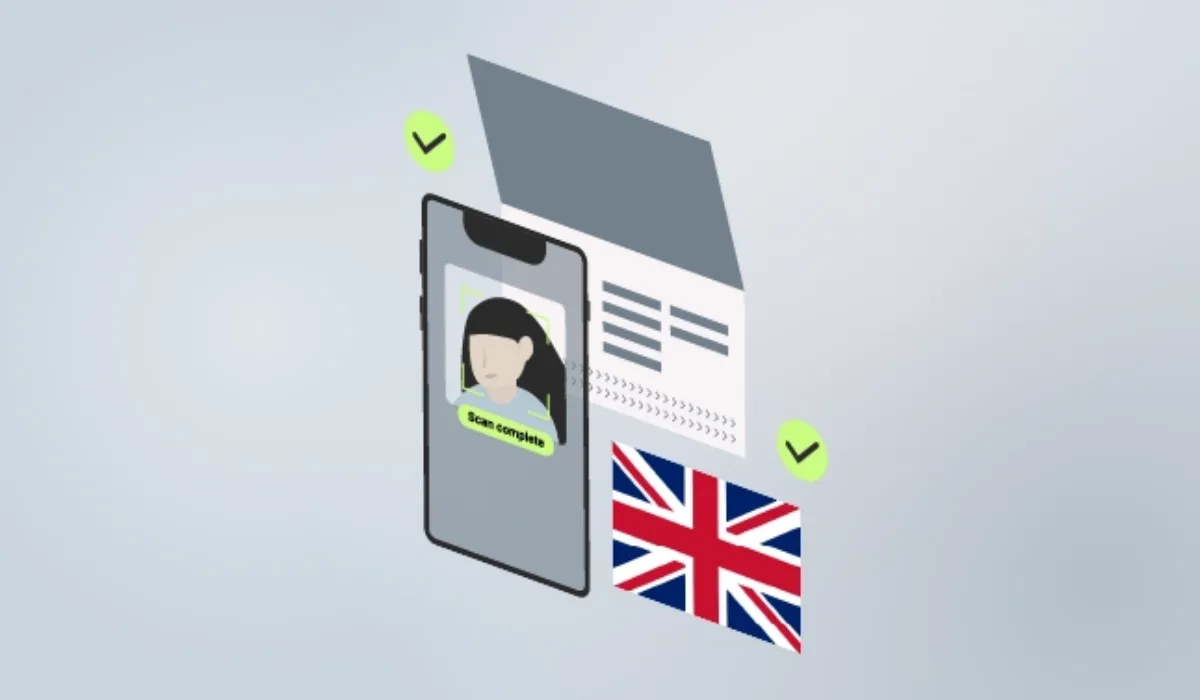
In practice, it means that when you register a UK-based company or take on a leading position at a UK business, you need to prove that you are who you say you are. Typically, this is done by uploading identity documents and completing digital checks through the Companies House’s verification system.
This system ensures that every UK company on the register can be traced back to actual (real) individuals, so that no one can hide behind nominees or fictional identities. Namely, it eliminates the bad practice of registering companies with made-up details just to open bank accounts or bid for contracts under false pretenses.
To illustrate: before this system was in place, anyone could register as a director using a fake name and date of birth, with minimal checks. But now, a strong confirmation is required that you and your name are real.
More so, Companies House identity verification creates what’s called a „verified identity” on the Companies House system. Once completed, your identity is confirmed and linked to your role in the company. From that point on, anyone filing documents on behalf of the company needs to have this verified status. And this verified identity then travels with you across all your directorships or other qualifying roles.
Why the UK Introduced Identity Verification for Companies House
The UK’s company register historically has been favored for its accessibility and openness. But, at the same time, it was criticized for being too easy to misuse.
Thus, according to the UK government’s own analysis, the ease of setting up a UK company made the register attractive not just for legitimate businesses, but also for money launderers, fraudsters, and those looking to hide illicit activity behind corporate structures. Therefore, fraud remains one of the most frequently reported crime types in the UK, with estimates suggesting that around 40% of all crime experienced by individuals is fraud.
In the same vein, Transparency International UK in its reports on offshore shell companies and hidden ownership, demonstrates how billions of pounds of suspect funds are linked to UK investments when beneficial ownership is not transparent.
One of the reasons this occurred is that Companies House traditionally operated as a passive registry; i.e., it used to accept information at face value without verifying whether the people listed as directors or shareholders actually existed or consented to those roles. This created opportunities for abuse: everything from identity theft to using UK companies as fronts for international fraud schemes.
„Identity verification will help make sure that the people setting up, running, and controlling companies are who they say they are. This will make our data more reliable and less open to misuse, supporting a more transparent and trusted business environment.” Andy King, CEO of Companies House
So, the introduction of the Companies House identity verification process made it mandatory to verify the identities of business representatives before they can control or even register companies. Now, there is greater confidence that the information the UK registry officials are seeing is accurate and that real, accountable individuals are behind the business.
In a nutshell, identity verification was introduced to:
- Reduce the risk of false identities on the register
- Improve public confidence in company data
- Support broader efforts to deter economic crime
When Did Identity Verification Become Mandatory?
There’s been some confusion about when identity verification actually became a legal requirement in the UK.
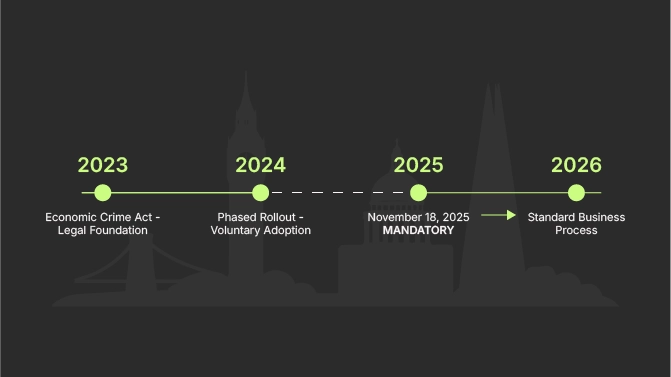
It all started in 2023 with the Economic Crime and Corporate Transparency Act 2023, which represented the most significant reform to Companies House in decades. This act set out a number of registry reforms aimed at improving transparency and combating corporate fraud.
Identity verification began rolling out in phases in 2024, but it didn’t become a legal requirement immediately. Early adopters could verify voluntarily, and Companies House encouraged people to get ahead of the curve. But, on November 18, 2025, identity verification shifted from optional to mandatory.
From that date on, anyone filing certain documents with Companies House must have a verified identity, including new company formations, changes to directors or people with significant control (PSCs), and various other filings where you’re asserting control or authority over a company.
This means that for businesses 2026 is the first full calendar year where identity verification is embedded into normal Companies House processes. So, businesses that delayed or ignored earlier nudges are finding they can’t proceed with routine filings now. The grace period is over, and verification is now a standard part of managing a UK company.
Who Needs to Verify Their Identity?
Not everyone connected to a company needs to verify their identity. The Companies House identity verification focuses on individuals who have legal authority or control.
- Directors – the individuals legally responsible for running the company. This makes sense, as directors have significant legal responsibilities and power to bind the company to contracts, manage its affairs, and make decisions on its behalf.
- People with Significant Control (PSCs) – those who own or control large stakes in the company. Corporate PSCs are individuals who own more than 25% of a company’s shares, hold more than 25% of voting rights, or otherwise have significant influence or control over the company.
- Certain company officers or agents or people submitting filings to Companies House. The idea here is to prevent someone from filing false information anonymously.
So, if you’re simply an employee, a minority shareholder without significant control, or a professional advisor who isn’t filing documents on behalf of clients, you probably don’t need to verify.
To make sure who is in scope, you can check the UK government’s official policy page.
How Companies House Identity Verification Works in Practice
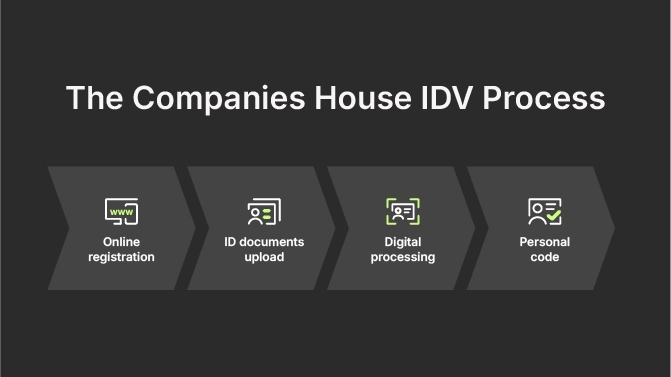
The Companies House identity verification process is designed to be straightforward, secure and user-friendly. It’s an online process during which a user needs to create an account, then work through a digital identity check. Here’s how it looks:
- Online registration: Individuals use a secure government service to begin verification.
- Upload ID documents: Companies House accepts UK passports, biometric residence permits, and various other government-issued IDs.
- Digital processing: A combination of automated checks confirms authenticity. Users confirm their names, date of birth, and other personal information to ensure consistency across the system.
- Personal code: Once verified, a user receives a „Companies House personal code” – a unique identifier that confirms their verified status. Later this code can be used when filing documents, registering new companies, or updating information on existing ones.
Usually, the entire process of identity verification takes around 10-15 minutes if you the right documents are at hand. The system gives people clear steps to complete verification online. Some people, however, report delays if their documents are damaged, outdated, or if the facial recognition software struggles. For example, poor lighting and low-quality phone cameras can occasionally cause hiccups.
What Happens if Identity Verification is Not Completed?
If you haven’t verified your identity, you simply can’t file documents with Companies House that require verification. This means you can’t:
- Register a new company
- File confirmation statements
- Update director or PSC information
- File annual accounts (if you need to sign or submit as an unverified person)
- Make changes to company structure or registered details
As you can see, the absence of verification can grind normal business operations to a halt. Delaying verification won’t help, because you’ll have to file something eventually – whether it’s routine compliance documents or changes driven by business needs. At that point, verification becomes unavoidable.
There are also potential legal consequences:
- Companies House may take compliance action if identity verification requirements are ignored
- Failure to verify can delay filings or affect appointments being accepted
- Directors who continue to act without verification may be committing a breach under the Companies Act and could face enforcement measures
But for most businesses, the real impact is practical, as missing verification creates compliance gaps, delays important filings, and can raise red flags with banks, investors, or partners who expect companies to maintain up-to-date records. The message is clear: verification isn’t optional anymore, and putting it off only creates headaches down the line.
Is Companies House Identity Verification Enough on Its Own?
Let’s be honest – Companies House identity verification is a big step forward, but it’s not a complete solution to every compliance or fraud risk businesses face.
What Companies House identity verification does well is confirm that the people running and controlling UK companies are who they claim to be. It makes the register more accurate, reduces the risk of fictitious directorships, and gives the public greater confidence in company information. But what it doesn’t do is replace all the other checks and obligations businesses have, such as:
- Anti-money laundering (AML) regulations still apply to many sectors. If you’re a financial institution, accountancy firm, estate agent, or legal practice, you’re already required to conduct Customer Due Diligence(CDD) that goes beyond what Companies House checks. Identity verification at Companies House doesn’t replace your own AML obligations to understand your customers’ risk profiles or source of funds.
- Know Your Customer (KYC) checks that businesses conduct when onboarding clients or partners often involve additional layers: proof of address, business legitimacy checks, sanctions screening, and ongoing monitoring. Companies House verification is one data point in this process, but it’s rarely the only one.
- Regulatory compliance requirements in specific industries, such as finance, healthcare, or legal services, often demand more rigorous checks than what Companies House provides. Being verified at Companies House doesn’t exempt you from sector-specific compliance frameworks.
To sum up, Companies House identity verification is a foundational layer of transparency and accountability in the UK business environment. And it addresses a real problem. But it exists alongside, not instead of, the other compliance responsibilities businesses already carry.
Identity Verification Beyond Companies House
Companies House verification is just a part of a much broader framework of how businesses approach identity verification and compliance. Most companies already have internal processes for verifying the identity of employees, contractors, suppliers, and customers.
- Banks and financial institutions verify directors before accounts are opened
- Professional advisors confirm client identities as part of their regulatory duties
- Internal governance processes require identity checks for senior personnel
There is a layered approach to identity verification. While Companies House verification establishes a baseline of public transparency, individual organizations often need additional checks to meet their own legal and risk standards. For example, depending on the industry, businesses also:
- Check IDs during recruitment
- Conduct background checks for key hires
- Verify customer identities during onboarding (especially in regulated industries)
- Screen against sanctions lists or Politically Exposed Persons (PEP) databases
- Monitor transactions for suspicious activity
And when it comes to companies operating internationally, identity verification might also involve cross-border checks, understanding beneficial ownership structures in other jurisdictions, or complying with foreign regulations like the EU’s Anti-Money Laundering Directives (EU AMLD) or the US Foreign Account Tax Compliance Act (FATCA).

What This Means for UK Businesses in 2026
In 2026, Companies House identity verification has shifted from reform to routine. It’s a mandatory part of running a UK company. So, if you haven’t verified yet, make it a priority. It’s not going away, and delaying only complicates routine business activities.
Here is what this means for your UK business in 2026:
The end of anonymity
Directors and corporate PSCs are no longer just names on a page – you are now verified individuals with traceable identities. This shift replaces anonymity with accountability, ensuring that those in charge cannot hide from their legal responsibilities.
Governance as a competitive edge
Identity verification is a litmus test for good governance. Maintaining accurate records and timely filings is a reputational asset, as investors and lenders favor companies with robust compliance. Moreover, it adds legitimacy to businesses, making them more transparent and helping avoid the regulator’s scrutiny, which can slow down operations.
A more powerful Companies House
Under the 2023 Act, Companies House has evolved from a passive register to an active regulator. With new powers to query suspicious filings and share data with law enforcement, businesses should expect increased oversight rather than less.
All this doesn’t mean that running a UK company has become impossibly burdensome. For the vast majority of legitimate businesses, these changes simply formalize what should already be happening: being transparent about who’s in charge, keeping records accurate, and operating with integrity.
In conclusion, for honest, competent owners, verification is a minor administrative step, not a threat. It cleans up the business environment by removing bad actors and raising standards across the board. In 2026, compliance is the foundation for a successful, credible brand.
FAQ