
KYC Requirements in Canada: What Businesses Need to Know to Stay Compliant


If your business operates in Canada, especially if you move, lend, exchange, or invest money, you need to pay attention to this statistic: according to the Criminal Intelligence Service Canada (CISC), between CAD $45 billion and CAD $113 billion is laundered in the country every single year. This sum is approximately equal to the annual GDP of such countries as Bulgaria or Uzbekistan!
That is precisely why KYC compliance in Canada isn’t optional: compliance rules are becoming stricter, and penalties are getting larger than ever before. In this article, we’ll discuss what KYC compliance looks like in Canada, when it’s triggered, and how businesses can operationalize it without turning onboarding into a bottleneck.
Who Needs to Comply with KYC Requirements in Canada
Know Your Customer (KYC) obligations in Canada flow from one central piece of legislation: the Proceeds of Crime (Money Laundering) and Terrorist Financing Act (PCMLTFA), enforced by the Financial Transactions and Reports Analysis Center of Canada (FINTRAC).
Any business classified as a reporting entity under the PCMLTFA must have a full KYC and Anti-Money Laundering (AML) compliance program in place. Reporting entities in Canada include:
- Financial institutions, such as banks, credit unions, trust/loan companies
- Money services businesses (MSBs) and foreign MSBs – currency exchange, money transfer, cheque cashing, cryptocurrency dealing, and crowdfunding platforms
- Securities dealers – investment firms, portfolio managers, exempt market dealers
- Life insurance companies, brokers, and agents
- Real estate brokers, sales representatives, and developers (for certain activities)
- Mortgage administrators, brokers, and lenders
- Armored car carriers
- Financing and leasing entities, cheque cashers, and factors
- Casinos
- Accountants and accounting firms (for certain activities)
- Dealers in precious metals and stones
- Agents of the Crown that sell money orders
- British Columbia notaries (for certain activities)
So, if you’re a fintech, crypto platform, or payments business, the MSB category is where your company lands, meaning you must register with FINTRAC before you can legally operate. Also, FINTRAC explains that there are Canadian MSBs and foreign MSBs, and it lays out criteria to determine whether you’re a Canadian MSB or a foreign MSB.
In 2024–2025 alone, FINTRAC issued 23 notices of KYC compliance violation – the largest number in its history, totaling more than CAD $25 million in penalties. Source
When KYC Is Required
KYC is triggered by specific transactions and circumstances. Canada’s KYC trigger points are tied to specific “transactions and activities” under the regulations and FINTRAC guidance. Here is the list of the triggers that show up most often in real compliance operations:
- Cash transactions of CAD $10,000 or more – single or aggregated within 24 hours. Here, the “24-hour rule” means that multiple smaller cash deposits that add up to CAD $10,000+ are treated as one.
- Electronic funds transfers of CAD $1,000 or more
- Virtual currency transactions of CAD $1,000 or more
- Foreign currency exchange of CAD $3,000 or more
- Redemption or issuance of negotiable instruments – money orders and traveler’s cheques worth CAD $3,000 or more
- Account opening – identity verification is required before opening any account or entering into a business relationship
- Any suspicious transaction, regardless of amount – if something seems off, you must verify and file a Suspicious Activity Report (SAR)
- Politically Exposed Persons (PEPs) and transactions exceeding CAD $100,000 require Enhanced Due Diligence (EDD)
Key KYC Requirements for Canadian Businesses
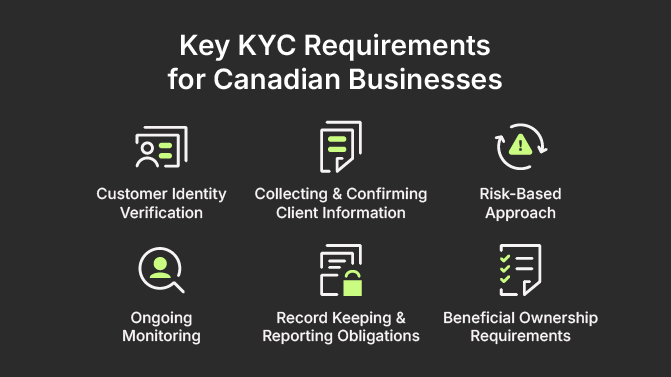
In Canada, businesses (reporting entities) are expected to have a program that consistently produces verifiable KYC results and an audit trail. In particular, FINTRAC states that all reporting entities must establish and implement a compliance program, which is the foundation for meeting reporting, record-keeping, identity verification, and other KYC requirements.
Let’s take a closer look at the main KYC requirements that typically make (or break) compliance in practice.
Customer Identity Verification
Every reporting entity must verify the identity of its customers when KYC triggers apply.
For individuals, you must confirm they are who they say they are using one of FINTRAC’s approved methods. The document or information used must be authentic, valid, and current, and expired IDs don’t count.
For business clients, such as corporations, trusts, partnerships, funds, and unincorporated organizations, you must confirm the entity’s legal existence using records such as a certificate of incorporation, a partnership agreement, or other official documentation.
EXAMPLE: A fintech onboarding a small business client can’t just take the CEO’s word for it. They need to verify the corporation exists. This is typically done by pulling a corporate registry record and then verifying the identity of the authorized representative.
Collecting and Confirming Client Information
Beyond client identification information, you must collect, confirm, and record specific information. For individuals, this includes:
- Full legal name
- Home address
- Date of birth
- Occupation or nature of principal business
For entities, it includes legal name, address, nature of principal business, and registration/incorporation details. This information must be kept on file and accessible because FINTRAC requires you to keep a record of the purpose and intended nature of the relationship, and can request records within 30 days, so you need to be ready to produce them.
Risk-Based Approach
Canadian KYC law doesn’t require identical treatment for every client. Instead, it requires a proportionate treatment based on the assessed risk, since higher-risk clients and transactions demand more scrutiny.
The indicators for low-risk include established Canadian residents, simple transactional activity, and clients in regulated industries. High-risk factors include politically exposed persons, clients from high-risk jurisdictions flagged by FATF, complex corporate structures, and unusual transaction patterns.
In practice, this means building a documented risk assessment methodology, tiering your clients, and applying enhanced due diligence to those at the top of the risk scale. Importantly, your KYC compliance program must document how risk levels are assessed, as FINTRAC examiners will check that.
Ongoing Monitoring
KYC doesn’t end at onboarding. You’re required to continuously monitor client activity and keep information up to date throughout the business relationship. In other words, ongoing monitoring is not optional once you have a business relationship.
You’re obliged to:
- Watch for transactions that are inconsistent with a client’s profile
- Update client records when information changes
- Re-verify identity if information becomes outdated or doesn’t align with usual behavior
- Reassess risk levels as circumstances evolve
EXAMPLE: A small import business you onboarded two years ago suddenly starts receiving large international wire transfers from a jurisdiction you wouldn’t expect. That behavioral shift should trigger a review, possibly a re-verification of beneficial ownership, and a closer look at the source of funds.
Record Keeping and Reporting Obligations
Reporting entities must maintain comprehensive records and submit specific reports to FINTRAC. Key obligations include:
- Large Cash Transaction Reports (LCTRs) for cash receipts of $10,000+
- Electronic Funds Transfer Reports (EFTRs) for international EFTs of $1,000+
- Suspicious Transaction Reports (STRs) for any transaction with reasonable grounds to suspect money laundering, terrorist financing, or sanctions evasion
- Virtual Currency Transaction Reports (VCTRs) for crypto transactions of $10,000+
- Terrorist Property Reports – when you know or suspect you hold property owned by a terrorist
All records must be retained for a minimum of 5 years from the date the business relationship ends or the transaction occurs. Records must be producible to FINTRAC within 30 days of a request.
It’s important to note that since you’re collecting sensitive personal data to meet KYC obligations, privacy compliance must be built into your process. FINTRAC explicitly states that personal information used in Canadian commercial activities is protected by the Personal Information Protection and Electronic Documents Act (PIPEDA) or similar provincial legislation, and that you must inform clients about the collection of their personal information.
Beneficial Ownership Requirements
When your client is a business, you need to review its corporate structure and identify the real people behind it. Thus, FINTRAC requires the identification of all individuals who directly or indirectly own or control 25% or more of the entity, plus directors and authorized representatives – aka beneficial owners.
Practically speaking, when verifying a client’s identity (entity’s identity), you need to obtain information such as:
- Names of all directors (for corporations)
- Names and addresses of individuals who directly or indirectly own/control 25%+ (with entity-type nuances)
- Ownership, control, and structure information
As of October 1, 2025, new obligations require reporting entities to report material discrepancies between their beneficial ownership records and information in Corporations Canada’s database. This applies specifically to federally incorporated companies assessed as high-risk for money laundering.
EXAMPLE: You’re onboarding a numbered company as a client. On paper, it’s owned by a holding company in another Canadian province. You’re required to trace through the structure to find every natural person who owns 25%+. If that trail leads to four individuals, all four must be identified and recorded.
How Businesses Comply with KYC in Practice
Turning legal obligations into operational processes is where most compliance programs either succeed or fall apart. In practice, KYC-compliant Canadian businesses should follow certain requirements.
First, you need to build a written compliance program covering policies, procedures, and controls. FINTRAC requires this to be documented and followed, not just have it theoretically in place.
Second, you must appoint a compliance officer responsible for overseeing the program, staying current on regulatory changes, and training staff.
Third, you need to create onboarding workflows that capture required client data, trigger the right verification method, and flag high-risk attributes for escalation.
The next step is setting up digital transaction monitoring systems that generate alerts for unusual activity, because manual reviews of every transaction don’t scale.
Fifth, you must establish reporting protocols so that when an STR needs to be filed, there’s a clear process for who does it and how quickly.
A solid Canadian KYC process must have defined paths for:
- pass
- fail/do not onboard
- needs more information
- suspicion reached = STR workflow and narrative drafting
- high risk = enhanced measures / more frequent ongoing monitoring
And, finally, you need to invest in regular staff training. Your people should be able to recognize red flags, handle sensitive client situations, and understand what triggers a SAR report.
To make sure all of these requirements are not only present on paper, recently FINTRAC has shifted toward assessing whether compliance programs are effective at identifying and mitigating risk.
Identity Verification Methods Accepted in Canada
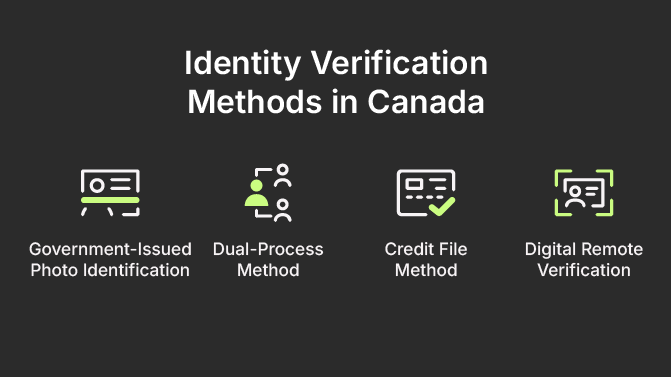
FINTRAC accepts five methods for verifying the identity of an individual. But the three methods businesses most commonly use in practice are as follows:
Government-Issued Photo Identification
This is the most direct method – checking a valid, current identity document issued by a federal, provincial, or territorial government. It must include the person’s full name, a unique identifier number, and a photograph (for example, a passport, driver’s license, or provincial ID card).
If the client is not physically present, you can still use this method, but you must use technology to authenticate the document. A scanned or photographed ID isn’t enough on its own. That’s why the software capable of assessing the document’s authenticity is required, which is typically paired with a selfie or live video to confirm the photo matches the person.
Dual-Process Method
This method uses two independent, reliable sources of information to verify identity, neither of which can be the reporting entity or the client themselves. Acceptable sources include government records, financial institutions, and utility providers. Each source must confirm the individual’s name, and together they must confirm either their address or date of birth.
EXAMPLE: You can confirm someone’s name and address via a bank statement, then confirm their name and date of birth via a government benefit letter, which represents two independent sources, two pieces of corroborating information.
Credit File Method
In this method, the identity is verified by checking a Canadian credit bureau file, such as Equifax or TransUnion. The file must be at least three years old, sourced from more than one creditor, and must match the client’s name, address, and date of birth. The check must be done at the time of verification, not pulled from an old report. Minor discrepancies in name spelling or address format can be acceptable, but a mismatch in date of birth is generally not.
Digital Remote Verification
Remote digital verification is explicitly permitted by FINTRAC and is how most digital-first businesses in Canada handle KYC. The method typically combines the government-issued photo ID method with liveness detection – software that confirms a real person is present, not just using a photo of a photo – and document authentication technology that checks for tampering, correct fonts, security features, and more. This is the area where technology has advanced most rapidly, enabling customers anywhere in Canada to verify their identity in seconds.
Common Challenges of Meeting KYC Requirements in Canada
Even with clear guidance, Canadian KYC can get tricky fast, especially for high-growth companies. And even well-intentioned businesses can run into real friction points.
Remote onboarding of clients without Canadian documents. Verifying a foreign national using foreign identity documents is permitted in Canada, but requires careful attention to equivalency standards and document authenticity. Dual-process verification becomes harder when the two reliable sources aren’t Canadian.
Beneficial ownership complexity. Tracing ownership through multi-layered corporate structures, especially when some entities are registered in other jurisdictions, is time-consuming and can depend on the quality of information available in foreign registries.
Keeping records current. Clients change addresses, directors change, and ownership structures evolve. Without a systematic process for re-verification and record updates, customer files can drift out of compliance.
Scaling manual processes. A compliance team that handles 50 onboardings a month can do a lot manually, but the one that handles 5,000 cannot. Manual document review, risk scoring, and transaction monitoring create bottlenecks and inconsistencies as volumes grow.
Staying current with regulatory changes. Canada updated the PCMLTFA significantly in 2024, and new sectors continue to be added. So, compliance programs that aren’t reviewed regularly can fall out of step with current requirements without anyone noticing.
Consequences of Non-Compliance
The consequences of failing to meet FINTRAC’s requirements are real and public. FINTRAC publishes the names of non-compliant entities alongside their penalties. Violations are cumulative, each deficiency is assessed separately, and totals can mount quickly.
In 2024-2025, FINTRAC issued more than $25 million in penalties across 23 notices of violation – the most in its history. It also disclosed 32 cases of non-compliance directly to law enforcement for potential criminal investigation, more than double the previous year.
Beyond fines, there are real business consequences: loss of operating licenses, forced remediation programs, reputational damage with banking partners, and, in serious cases, criminal referrals. For businesses that rely on correspondent banking relationships or payment rails, being publicly identified as non-compliant can disrupt access to essential financial infrastructure.
How Businesses Simplify KYC Compliance
There are two broad approaches to KYC – manual and automated. The difference matters more as a business scales.
Manual processes involve collecting documents over email, reviewing them by eye, and recording information in spreadsheets. Naturally, such processes are prone to human error, hard to audit consistently, and create staff dependencies that don’t scale. They also make it difficult to enforce consistent risk scoring across different onboarding staff.
Automated and technology-assisted compliance is the direction most businesses are heading. This typically involves identity verification platforms that handle document authentication, liveness checks, and data extraction automatically; AML screening tools that check clients against sanctions lists and PEP databases, as well as review terrorist financing risks; and transaction monitoring systems that surface unusual patterns rather than relying on staff to spot them manually.
Some businesses build in-house compliance technology stacks, while others work with specialist KYC software providers that integrate directly into onboarding workflows. For businesses handling large volumes, the main question isn’t whether to automate, but rather which parts of the process to automate first.
The goal in either case is the same: a KYC compliance program that reliably identifies who your customers are, assesses the risk they represent, monitors how they behave, and produces clean records that can survive a FINTRAC examination.
Meeting that bar manually is possible for small operations. But for bigger organizations, technology is the only way to keep compliance programs consistent, auditable, and cost-effective.
*Disclaimer: This article is for informational purposes and does not constitute legal advice.
FAQ