
KYC Requirements in the UK: A Complete Compliance Guide for Businesses

The United Kingdom has been a titan of global finance for centuries. When the world needs to agree on how banks should hold capital, how insurance should be priced, how securities should be disclosed, or how a central bank should act in a crisis, it has, repeatedly and consistently, looked to frameworks first built in London.
But with great influence comes a massive target on the back of every British business, especially when it comes to criminals trying to misuse the UK financial system through money laundering, sanctions evasion, and fraud. To protect your UK business from such threats, you need to understand the Know Your Customer (KYC) requirements.
This guide explains the UK’s KYC framework, who must comply, what checks are expected, and how UK companies can build efficient and scalable processes.
What Are KYC Requirements in the UK?
Part of the broader Anti-Money Laundering (AML) framework, KYC is a mandatory process used by businesses to verify the identity of their individual and corporate clients and answer the question: Do we know who we are dealing with, why they are using our service, and whether the relationship makes sense for the risk?
More than £100 billion is laundered through or within the UK each year. The UK Financial Intelligence Unit (FIU) received 866,616 Suspicious Activity Reports (SARs) in 2024–25, with £382.6 million denied to suspected criminals through Defense Against Money Laundering requests.
KYC requirements in the UK are mainly associated with Customer Due Diligence (CDD) – the process of verifying customer identity by checking such information as their name, date of birth, address, and official identity documents.
Practically speaking, all UK businesses need to ensure that every new client’s identity matches their official documentation before allowing them to enter into a business relationship.
The UK does not take a unique KYC approach but rather follows international AML standards set by the Financial Action Task Force (FATF), whose recommendations emphasize a risk-based approach, under which countries and firms should identify the highest money laundering and terrorist financing risks and focus resources there.
| Global AML standard | UK implementation | |
|---|---|---|
| Customer checks | Identify and verify customers | CDD, ultimate beneficial ownership checks, ongoing monitoring |
| Reporting | Suspicious transaction reporting | SARs submitted to the UKFIU/NCA |
| Corporate transparency | Beneficial ownership transparency | Companies House PSC register and identity verification |
| Supervisors | National regulators | FCA, HMRC, professional bodies, Gambling Commission, and others |
The only thing that makes UK’s KYC regulations stand out is the strong focus on sector-specific supervision, Companies House transparency reforms, and the central role of the UK FIU in receiving SARs.
KYC Regulations and Legal Framework in the UK
If you’re operating in the UK, your compliance “playbook” consists of several key pieces of legislation and the watchful eyes of specific regulatory bodies. Let’s review the core of the UK’s KYC/AML framework:
Main regulations in the UK:
- The Money Laundering, Terrorist Financing and Transfer of Funds Regulations 2017 (MLR 2017)
- Proceeds of Crime Act 2002 (POCA)
- Terrorism Act 2000 (TACT)
- Criminal Finances Act 2017
Main legislative bodies in the UK:
- The Financial Conduct Authority (FCA) – supervises UK banks, building societies, credit unions, crypto-asset businesses, and many financial services firms for AML compliance.
- HM Revenue & Customs (HMRC) – supervises several non-FCA sectors, including money service businesses, high-value dealers, trust or company service providers, accountancy service providers, estate agents, letting agents, and art market participants.
- National Crime Agency (NCA) / UKFIU – receives, analyzes, and disseminates SARs. The NCA says SARs provide intelligence from the private sector that would otherwise not be visible to law enforcement.
- The Office of Financial Sanctions Implementation (OFSI) – provides guidance on UK financial sanctions, which often sits alongside KYC because firms need to screen customers, beneficial owners, and counterparties against sanctions lists.
Who Must Comply with KYC Requirements in the UK?
People often think that KYC is only for banks, or strictly financial institutions. In reality, the UK’s regulated sector is quite broad. So, if your UK business falls into any of these categories, you are legally required to perform KYC:
- Financial institutions. Banks, building societies, credit unions, investment managers, stockbrokers, e-money institutions, payment institutions, lending firms, financial advisers, investment firms, asset managers, and safety deposit providers
- Legal professionals. Lawyers and notaries, when handling property or money transactions
- Real estate agents: Both residential and commercial
- Accountants and tax advisors. Including auditors and insolvency practitioners
- Casinos and gambling providers. Both physical and online
- High-value dealers. Any business accepting cash payments of €10,000 or more for goods, for example, jewelry or car dealers
- Crypto-asset providers. Since 2020, crypto exchanges and wallet providers must register with the FCA and follow AML/KYC rules
EXAMPLE: A fintech opening e-money accounts, an estate agent handling property sales, and an art dealer accepting high-value payments – all of them need KYC controls, even though their business models look very different.
Core KYC Obligations for UK Businesses
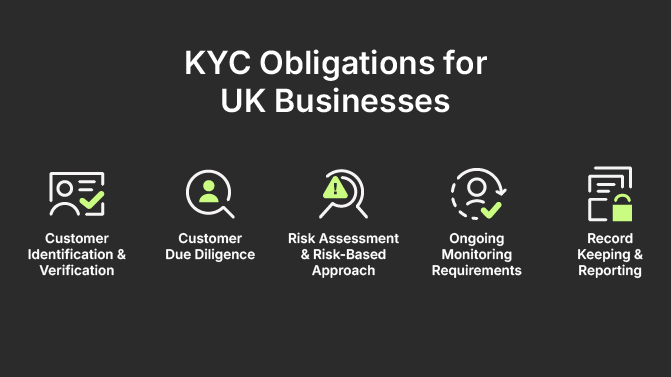
To be compliant, you can’t just take a client’s word for it. You need a robust system and a step-by-step process: identify the customer, verify the information, understand the relationship, assess risk, monitor activity, keep records, and report suspicion.
Here are the key KYC obligations that UK-based businesses must fulfill:
Customer Identification and Verification
The first step is to collect data for identity verification. Businesses usually collect a customer’s name, date of birth, residential address, and evidence from reliable sources. Most of the time, the sources of such information are government-issued documents, such as a passport or a driver’s license. As for proof of address, it’s usually utility bills or bank statements.
What makes the UK unique is the shift toward digital identity. The UK government’s “Digital Identity and Attributes Trust Framework” encourages businesses to use secure, digital methods for verification, which often include biometric face matching, like a selfie compared to an ID photo, to prevent identity theft.
Other methods include document verification, database checks, and liveness detection.
Customer Due Diligence
Customer due diligence is the process of evaluating the risk a customer poses. Any time a UK business is trying to establish a new business relationship, a CDD check is required. If and when there are doubts about the customer, such as suspicions of money laundering, fraudulent financial transactions, or terrorist financing, a business must stop dealing with that customer.
The UK uses a three-tiered CDD approach:
- Simplified Due Diligence (SDD) – used for very low-risk clients, like public authorities.
- Standard Due Diligence – the default level for most customers that verifies identity and determines the nature of the business relationship.
- Enhanced Due Diligence (EDD) – required for high-risk situations, including Politically Exposed Persons (PEPs), like MPs, diplomats or foreign officials, and clients from countries identified as high-risk by the Financial Action Task Force.
Risk Assessment and Risk-Based Approach
UK regulators don’t expect businesses to treat every customer like a criminal. Instead, they urge businesses to focus resources where they matter most by applying a risk-based approach to AML.
For you, such risk management means assessing the specific risks your business faces based on your location, your customers, and your products. For example, if you sell luxury watches in London, your risk is higher than that of a local book-keeping service in a rural village.
Ongoing Monitoring Requirements
You can’t just do KYC once and forget about it. You must monitor the relationship with your customer for as long as it exists.
In particular, HMRC requires UK businesses to update customer information, so they can revise customer risk assessments when circumstances change, while the FCA expects companies to maintain CDD and ongoing monitoring policies and procedures.
This means looking out for red flags, such as sudden, massive transactions that don’t match the client’s known income, or a client suddenly moving funds to a sanctioned jurisdiction.
Record Keeping and Reporting
Under the MLR 2017, you must keep records of your KYC checks for five years after the business relationship ends, including:
- records of CDD measures,
- customer identification documents,
- risk assessments,
- AML policies,
- controls and procedures,
- training records.
So, if you spot something suspicious, you are legally obligated to file a suspicious activity report with the NCA, which then alerts law enforcement to potential money laundering or terrorist financing, as well as provides valuable intelligence.
KYC for Individual vs. Corporate Clients
While verifying a person is more or less straightforward (verify the person’s identity, address, risk profile, sanctions exposure, and expected activity), verifying a company, also known as Know Your Business or KYB, is a different and more complex story.
When performing KYB or corporate KYC, you need to understand ownership, control, directors, ultimate beneficial owners, and, sometimes, the wider group structure.
In other words, KYB in the UK requires you to identify anyone who owns or controls more than 25% of the shares or voting rights – known as a Person with Significant Control (PSC). You can verify this through Companies House, but you must also verify that the information listed there is accurate and up to date.
| Individual KYC | Corporate KYC (KYB) | |
| Focus | Personal identity and source of funds | Structure, ownership, and control |
| Documents | Passport, utility bills | Certificate of Incorporation + Articles of Association |
| Key requirement | Biometric verification/ID verification | Identifying the Ultimate Beneficial Owner |
Common KYC Challenges for UK Businesses
Compliance can be a headache, as many KYC problems are operational rather than theoretical. That’s why, businesses often struggle with the following:
- Manual bottlenecks. Waiting days for a human to check a passport scan could kill the onboarding experience.
- Inconsistent risk scoring. If different reviewers assess the same type of customer differently, the business may apply the wrong level of due diligence, which makes it harder to prove that decisions are fair, consistent, and risk-based.
- Outdated customer files. Customer information can become inaccurate over time as addresses, ownership, business activities, or risk profiles change. If files are not refreshed, the business may miss new risks.
- Weak transaction monitoring. If customer activity is not monitored effectively, unusual or suspicious behavior may go unnoticed. For example, a customer’s transactions may suddenly increase in size or involve higher-risk jurisdictions.
- Poor audit trails. Businesses need to show how and why KYC decisions were made. Weak audit trails make it difficult to demonstrate compliance during internal reviews, audits, or regulator inspections.
- The cost of compliance. Between staff training and software, costs add up. However, the cost of a fine is always higher.
- Data privacy. Balancing KYC requirements with the UK GDPR is a delicate dance. You must collect data, but you must also protect it.
How to Conduct KYC Checks Efficiently
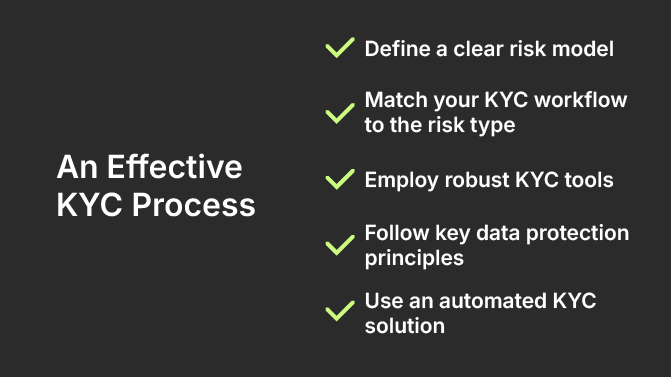
Start by deciding which factors increase risk: customer type, geography, products, payment methods, ownership complexity, sanctions exposure, politically exposed person status, and unusual behavior.
Then match the workflow to the risk. A low-risk individual may move through quickly with automated document and address checks. Meanwhile, a complex corporate client may need ownership mapping, PSC verification, source-of-funds review, adverse media screening, and senior approval.
And for that, you need to own robust KYC tools that help your team collect documents, verify identities, screen for sanctions and watchlists, identify beneficial owners, track risk decisions, trigger periodic reviews, and preserve an audit trail.
More so, good KYC tools should also support data protection principles. You should only collect and hold the personal data you need, and personal data should not be kept longer than necessary for the specified purpose.
The most successful UK firms are moving away from manual processes and toward automation. Automated KYC solutions can verify identities in seconds using AI and global databases – keeping the regulators happy and making your customers’ lives easier.
To implement all this effectively, look for solutions that offer:
- Real-time PEP and sanction screening
- OCR (Optical Character Recognition) to read documents automatically
- Liveness detection to ensure the person is physically present during a digital check
Consequences of Non-Compliance in the UK
The consequences of not performing KYC checks can be significant:
Fines. The Financial Conduct Authority (FCA) and HMRC have the power to levy fines that can reach into the millions. Only in 2025, the FCA reported total fines of £124,221,367.45, excluding court fines.
Prison time. Under POCA, senior managers can face up to 14 years in prison for serious money laundering offenses.
Reputational ruin. Once a business is named and shamed in an FCA press release, regaining client trust is nearly impossible.
Loss of confidence. Customers, partners, banks, investors, and regulators all want to see that a company can manage financial crime risk without creating unnecessary friction.
In 2024-2025, the FCA reported having enforced 37 final notices, 5 criminal convictions, over £186 million in fines, 1,456 firm authorization cancellations, and 135 formal intervention outcomes. Source
How KYC Helps Prevent Financial Crime
The NCA says money laundering underpins most forms of organized crime and can threaten UK national security, prosperity, and reputation.
KYC helps stop criminals from hiding behind fake identities, shell companies, stolen documents, nominees, and unusual transaction patterns. For a business, KYC helps protect customers, reduces exposure to fraud, helps avoid regulatory action, and supports trust in the company’s services.
10 Best Practices for KYC Compliance in the UK
KYC in the UK is demanding, but it is manageable when the process is clear, risk-based, and supported by the right controls. Here are 10 hands-on KYC tips to keep your business compliant:
- Build KYC around risk. Document why a customer is low, standard, or high risk, and make sure the evidence supports your decision.
- Keep policies practical. A KYC policy that staff cannot apply consistently will fail under pressure.
- Audit your process. Periodically review your KYC files. If an auditor walked in today, would they find everything in order?
- Refresh customer data. Trigger reviews when ownership changes, customer activity shifts, documents expire, or risk indicators appear.
- Do more for higher-risk clients. EDD should be visible in the file: extra verification, source of funds or wealth checks, senior approval, and tighter monitoring.
- Make reporting easy. Staff should know how to escalate suspicion to the nominated officer..
- Choose scalable technology carefully. Automation should reduce manual work, improve consistency, and create a clear audit trail, while leaving room for human review when a case is complex.
- Protect customer data. KYC teams collect sensitive information, so retention, access control, and deletion rules matter as much as onboarding speed.
- Never stop training. Laws change. Ensure your staff undergoes training on new AML requirements at least once a year.
- Adopt a “compliance first” culture. Compliance shouldn’t be a hurdle; it should be part of your brand’s promise of security and integrity.
To successfully stay compliant with UK regulations while onboarding customers, choose a KYC solution provider that offers smart automation, reliable verification, and AML coverage, so you can scale with confidence.
FAQ